

When “Woke” Traveled Without Context
A Tinder match in Vietnam revealed how political language spreads faster than history, people, or accountability.

I matched with a guy on Tinder while I was in Hoi An, Vietnam.
I usually don’t match with people when I’m traveling. I’m not a hookup girlie, and if I’m not going to be in one place long enough for it to make sense, then what’s the point. But Hoi An felt slower. I thought maybe I’d hang out with someone local, walk the ancient city, or head to Da Nang. So when a Vietnamese guy matched with me and said he was looking for friends and hangouts, I thought, okay. Sure.
Two messages in, he asked where I was from. He said he couldn’t tell.
Shout out to me and my perfectly curated Tinder profile, because yes — that was intentional. I told him about a few places I’d lived, mentioned that I was traveling through Southeast Asia, and left it there.
He replied:
“Oh wow. I’ve been here since birth. I’ve never left the country.”
Then, almost immediately:
“So are you one of those woke Americans? 🇺🇸😅”
I asked him what he meant. I asked him to explain.
This is something I do whenever someone says something that feels off. Asking people to explain forces them to sit with what they’ve actually said. It gives them a chance to clarify, correct themselves, or reveal what they really mean.
He told me I probably wasn’t familiar with the term. Then he sent me a definition of “woke” — which included awareness of social injustice, advocacy for equity, a term rooted in African American Vernacular English.
He ended the message with “Courtesy of ChatGPT.”
At that point, what I was trying to understand wasn’t the word itself. It was the frame he was operating from. Was he asking out of curiosity? Mockery? Suspicion? Was this supposed to be a joke? A test? A warning?
So I asked him again what he was actually asking me. What he wanted to know. Why was this coming up at all?
He backtracked. Said he was joking. Said it wasn’t funny. Said maybe he should ask a simpler question.
Related: Colonial Echoes at the Checkout Counter
I told him I don’t like assumptions. I like clarity. I also told him — plainly — that I’ve encountered racist Vietnamese people, so I prefer to be explicit about what’s being said.
He replied: “I don’t like racists. But I do make racist jokes sometimes with my friends.”
I unmatched him immediately.
There are levels to this.
On one hand, I felt a flicker of sympathy. He’s 30 years old and has never left his country. That’s not insignificant. Not everyone has the money, the passport access, or the freedom to move through the world easily.
I was also stunned by how casually he said that. Like it didn’t require explanation or apology. Like it was normal to tell a Black stranger that you make racist jokes and still expect to hang out afterward.
What did you think was going to happen next?
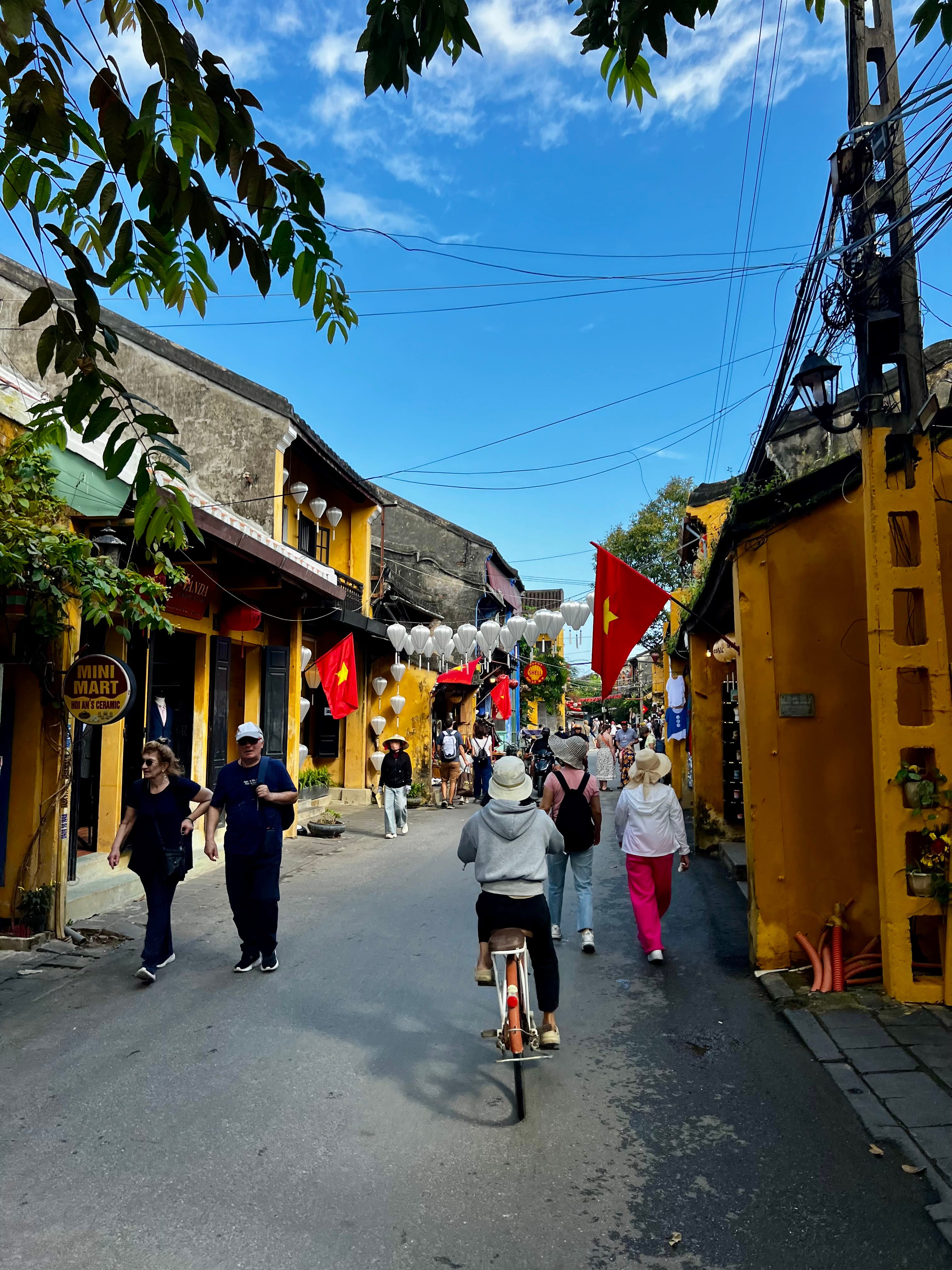
What stayed with me wasn’t just the comment. It was how familiar the moment felt. By the time this happened, I’d already spent weeks in Vietnam noticing how race, power, and history quietly shape everyday interactions. I’ve written before about how confusing it can be to move through a country deeply shaped by colonialism and war and still feel the weight of American racial dynamics playing out in small and ordinary moments.
So when he said “woke,” my eyebrow went up immediately.
That word didn’t start as a punchline. It came out of Black communities as a warning. A way of saying: stay alert. Pay attention. Over time, it was stripped of context, flattened, and repackaged as an insult — especially by conservatives who now use it as a catch-all for progressive social justice initiatives such as DEI, LGBTQ+ rights or Critical Race Theory they oppose in American media and politics. Sometimes they use it for people they feel are overly politically correct or radical. At this point, many Black people don’t even use it anymore because of how thoroughly it’s been distorted.
Which is why it was jarring to hear it thrown at me — by someone who had never left his country, and who had to ask ChatGPT what the word meant when pressed.
Related: What I Saw: Inside the War Remnants Museum
He had absorbed the language without the history. The attitude without the stakes. The joke without the cost.
This is what happens when ideas travel faster than people do.
He had access to the internet. To social media. To endless secondhand stories about Black people, American politics, and race. What he didn’t have was contact. He didn’t have lived experience. He didn’t have anyone in his life who complicated those ideas enough to make that kind of joke feel inappropriate to say out loud.
That’s when my public diplomacy brain kicked in.
More specifically, my cultural diplomacy brain.
At its simplest, cultural diplomacy is about people. It’s about exposure. About exchange. About what happens when you’re forced to reconcile the person in front of you with whatever assumptions you’ve been carrying.
What I experienced on Tinder was a failure of that process.
The language crossed borders.
The stereotypes crossed borders.
The context didn’t.
The people didn’t.
This is why I’m serious when I say every person should be required to travel internationally at least once in their life — and that it should be paid for by their government.
Not as a luxury. Not as a reward. As infrastructure.
We already know exposure changes people. We just treat it like a privilege instead of a public good. Exchange programs exist, but they’re limited and symbolic. Most people’s understanding of the world is still shaped by media, algorithms, and jokes made in group chats with people who all look and think the same.
And then we act surprised when those distortions surface casually, without shame.

I don’t believe travel magically makes people good. But I do believe it makes it harder to stay lazy. Harder to rely on stereotypes. Harder to joke about entire groups of people without knowing who you’re talking to.
Maybe if contact were systematic instead of accidental, this exchange wouldn’t have happened. Maybe he wouldn’t have felt so comfortable testing me with language he didn’t fully understand. Maybe I wouldn’t have had to unmatch someone who thought “I make racist jokes” was a normal thing to say.
What I do know is a world where ideas travel without bodies is producing a very specific kind of ignorance. One that feels informed, but isn’t. Connected, but isn’t. Global, but deeply narrow.
And if public diplomacy is supposed to do anything at all, it should start here — with people actually encountering one another, instead of meeting each other only through jokes, algorithms, and language people don’t fully understand. ⁂
Paid subscribers:
I shared a short photo essay from Hoi An this week — images and field notes from a city built on centuries of exchange.