

AI Is the New 'Who Did You Vote For?'
Data centers are humming, families are splitting, and "slop" has become a moral accusation. The American wedge issue is already at the table.


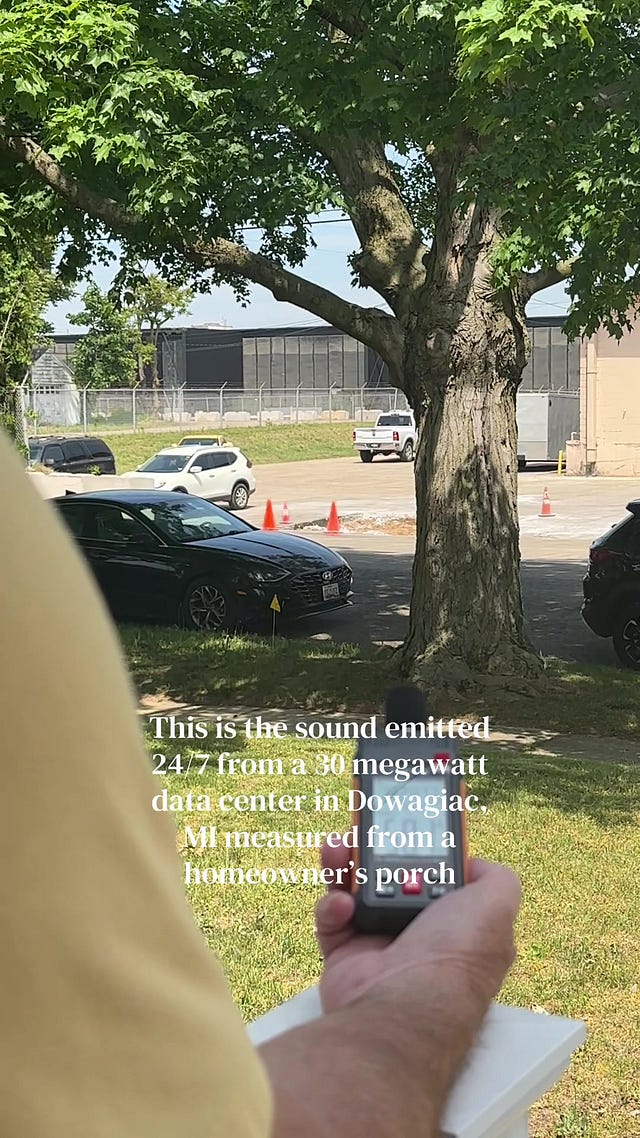
The man stands on his porch in Dowagiac, Michigan, pointing a sound level meter at the sky. He is measuring a hum. It comes from a data center down the road, a 30-megawatt building full of servers that never sleep, and neither, lately, does anyone who lives near it. The video, posted by journalist Aya Miller, has been watched more than 10 million times.
His neighbors describe headaches and nights without rest. Their lawsuit against the operator, Alliance Cloud Services, says the noise invades their homes and properties. Roughly 1,300 houses sit close enough to hear it. The facility has plans to grow from 30 megawatts to 340.
I watched the video three times from my apartment in Paris, an ocean and six time zones from Michigan. One commenter wrote, “I’m annoyed just listening to it on this video.” Below that, thousands of people were arguing, and not about decibels. People were sorting themselves. Whose fault? Whose progress? Whose future? Somewhere around the third replay I stopped asking how you stop a hum and started wondering what it’s doing to the way we see each other. The fight over AI has already left the policy papers and the copyright lawsuits. It is moving into neighborhoods, group chats, dating apps, and dinner tables, and it is changing shape as it travels. Politics asked people to declare a side. AI has them scanning each other for one.
 Tiktok failed to load.
Enable 3rd party cookies or use another browser
The body hears it first
Let’s start with what the hum does to a person. “This is a public health emergency,” one commenter wrote under one of the Dowagiac videos on TikTok. The research mostly agrees. Chronic noise exposure triggers the body’s stress response, raising blood pressure and heart rate and, over time, the risk of heart disease and stroke. The World Health Organization estimates that environmental noise, most of it traffic, costs Western Europe more than a million healthy life years annually. Low-frequency noise, the exact register of industrial cooling systems, carries its own research trail: stress, sleep disorders, and cardiovascular strain. Nighttime is the worst because the body repairs itself in the sleep the hum keeps interrupting.
In Sterling, Virginia, residents have taken to pressing mattresses and plexiglass against their windows to keep a data center’s whine out of their bedrooms. Keep Sterling in mind. We’re coming back to it.
Follow the hum
I started mapping where these data centers were opening, expecting to find that none of the towns were wealthy.
Dowagiac’s median household income is $38,433, about half of Michigan’s. Nearly a third of its residents live below the poverty line, more than double the state rate. In Vineland, New Jersey, a data center projected to use some 20 million gallons of water a year has drawn a federal lawsuit. Household income there runs about two-thirds of the state’s. Cumberland County has long been New Jersey’s poorest, and Vineland is a heavily Latine city where white residents are a minority.
Then Sterling broke my theory and replaced it with something worse. Sterling sits in Loudoun County, Virginia, which is the wealthiest county in America by median household income and home to “Data Center Alley,” the largest concentration of data centers on Earth. The hum did land in the rich county. But Sterling is Loudoun’s oldest, densest, most diverse corner, the affordable pocket where the county’s immigrants and working families live. Sterling Park was developed in 1962 with a covenant requiring its residents to be of the “Caucasian race.” A suburb built on exclusion became the county’s most diverse zip code, and now it’s the one with mattresses against the windows.
Under one of the Dowagiac videos, a commenter asked, “So the cops get called if your music is too loud but this is fine? lol.” It’s a zoning question. For years most zoning codes didn’t mention data centers at all, so they slid into the “light industrial” category, which in many places makes them by-right development: meet the standards, pull the permits, and build. There is no public hearing. No neighbors in a school gym. Housing, especially affordable housing, gets the opposite treatment: rezonings, special permits, and public hearings, the exact venues where opposition kills projects. Our land-use system hands a 340-megawatt hum an easier path than an apartment building. Communities are only now organizing against data centers the way they have long organized against dense housing, one land-use lawyer told Urban Land. In the first three months of this year, opposition blocked or delayed at least 75 projects worth about $130 billion, as much as all of last year combined.
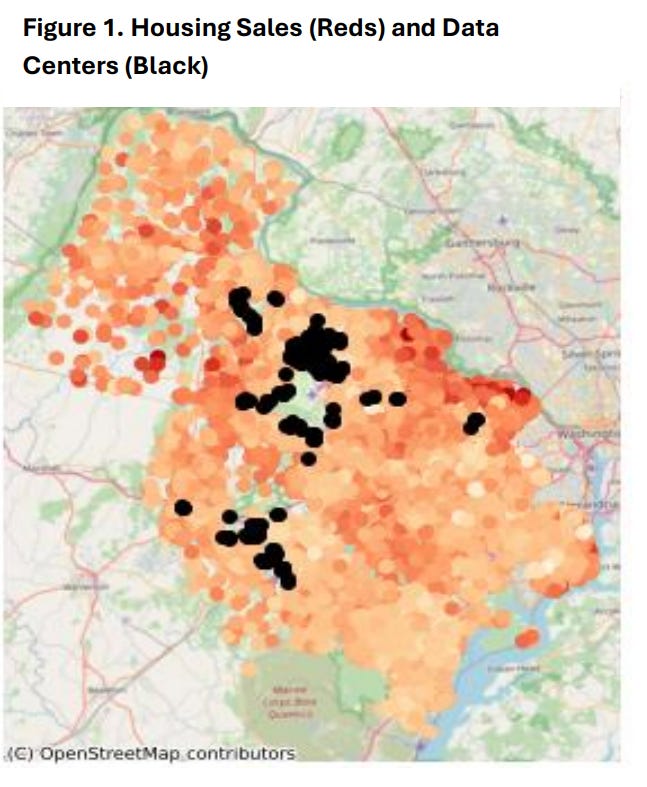
Strong infrastructure buoyed those prices, along with data-center tax revenue that has cut Loudoun’s residential tax rates by more than a third since 2010. In one Virginia neighborhood, a family moved their newborn to the basement to escape the vibration. The market can price the house. It cannot price what it takes to live in it. The people who bought those houses will probably be able to sell them. They just can’t sleep in them.
The new dirty word
Merriam-Webster and the American Dialect Society both named slop the 2025 word of the year, a word for machine-made content that carries the same disdain as junk or filth. Online, clanker circulates as a slur for AI. But the slur isn’t staying on machines. It’s landing on the people who use them.
Slop annoys me a little, I’ll admit. And still, I get it, because the grievances feeding it are real. The water. The power bills. The heat. Under one of the Dowagiac videos someone wrote, “Do you remember when going paperless was to save the environment?” A 24-year-old told Business Insider she couldn’t square her values with her prompts. She said she can’t be out there “composting and using a bamboo toothbrush” while feeding queries into ChatGPT.
Jessica, a colleague of mine, told me she used to hide her AI use from her eco-conscious friends while working at an agency that pushed it hard. Then she stopped hiding it, and mostly stopped using it. She could no longer “sit next to knowing the implications” and keep using it casually, she said. Another friend, eco-conscious like the rest, has started using AI to make flyers. “It’s a little awkward,” she told me. “I haven’t had that conversation with that friend yet.”
Online, that private discomfort turns quickly into accusation. One writer, who admits to using AI in his workflow, was told he was complicit in theft and possibly unwell for saying so. The fight has reached my own profession. In March, the Wall Street Journal profiled a Fortune editor who has published more than 600 AI-assisted stories in six months and says the mood around AI in newsrooms has shifted. Luddite, the 200-year-old word for the workers who broke machines, is a badge of honor again in The Nation and an insult at the Washington Post, whose editorial board wrote that a national ban on new data centers “would make the Luddites look good.” Same word, depending on who says it, and both sides are fighting over the same thing: the data centers.
The Turing test is now a first date
There is already a word for running your love life through a chatbot: chatfishing. An industry of wingman apps exists to do it for you. One woman told Vice she spent weeks in deep conversation on Hinge, childhood, attachment, the tender stuff, then met a man in person who had none of it in him. She had fallen for his chatbot’s replica. In one 2025 study, people chatting with GPT-4.5 and a human at the same time picked the AI as the human 73% of the time. The model had been told to act like a person, which is exactly what a chatfisher tells it to do. Close to one in four single adults in America now use AI somewhere in their dating lives.
One of my favorite scenes on television comes from the second season of Westworld, in 2018. An investor is asked to find the machine at a party and fails, because everyone there but him is a host. “We’re not…here yet,” Logan says, referring to our technological capabilities. Eight years later, the test moved to dating apps.
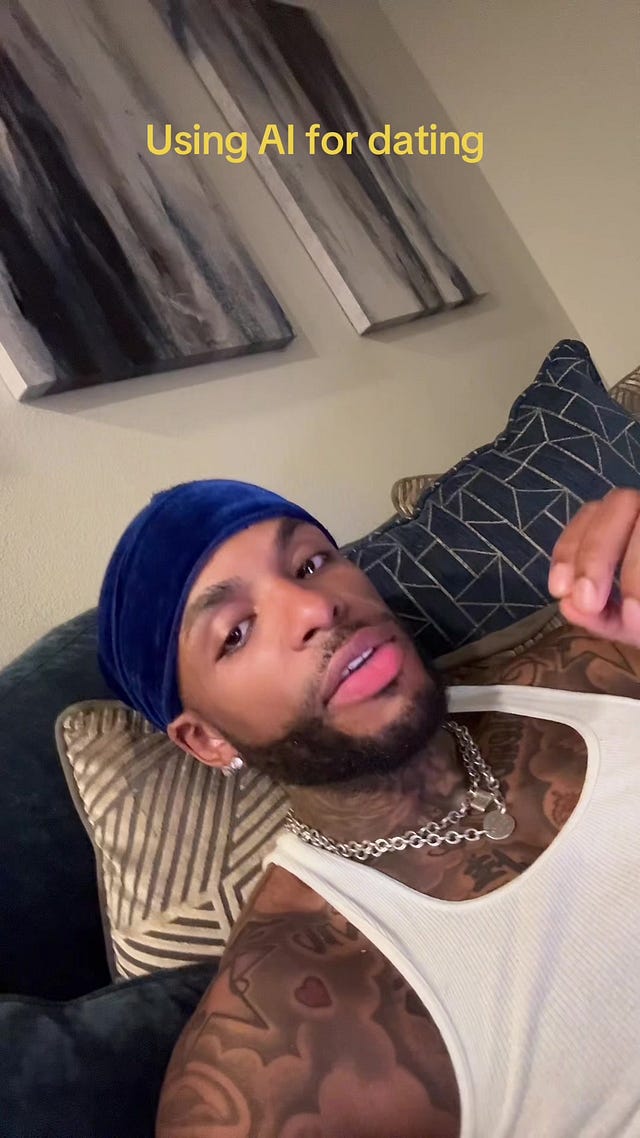
So daters are becoming forensic linguists. Avianté, a creator on TikTok, shared a story of easing back into dating after six intentional months away. He asked the woman he was talking to what she was looking for in a man. What came back was a document with clean headers, thematic categories, and a third-person point of view. And, he noticed, zero ellipses, when her ordinary texts were full of them, full of warmth and casualness and imperfection. Tell me this response is not GPT, he said. He knew her voice well enough to know this wasn’t it. She denied it. AI is everywhere now, she told him, and “people can’t tell the difference between what’s fake and real no more.” But to him, the imperfect thing, the flawed thought said out loud, was the brave part. The polished version felt lazy, he said.
 Tiktok failed to load.
Enable 3rd party cookies or use another browser
He is not alone in the feeling. A man on Reddit described his girlfriend consulting ChatGPT after their arguments and returning with its verdicts, “ChatGPT says you’re insecure” among them; the commenters told him to leave. The polling is starting to catch up: 64% of Gen Z daters say they wouldn’t date someone who leans on AI regularly, and singles rank a partner’s AI companion somewhere near still texting an ex.
Jessica answered my questions about this by voice note. Finding out a date ran her messages through ChatGPT would be “a red flag, just a little bit” because “you’re taking the fun out of the banter,” she said. Before things got serious, she would want the context. “Do you use it for nonsense, or are you using it to be more efficient in your day-to-day life?”
But sooner or later, there’s a date, and whoever charmed you with machine-polished paragraphs has to sit across from you at a table and sound like their texts.
Thirty minutes shorter
After the 2016 election, two economists used smartphone location data to show that Thanksgiving dinners bringing together opposite-voting households ran 30 to 50 minutes shorter than same-party ones, an estimated 34 million hours of family conversation gone. A later replication put the effect closer to 24 minutes. Politics literally shortened dinner.
I keep wondering what the AI version of that study will find, five years from now. Early signs are already at the table. A writer at Slate described her father, once her most generous advice-giver, now crediting “his sous-chef, ChatGPT” at dinner and holding up his phone so a robot voice could join the conversation. “I don’t want A.I.-assisted salmon,” she wrote. “I want a family recipe.” In the same piece, a 53-year-old mother described ChatGPT as a husband with no judgment while her daughter works to talk her back from it, and a 17-year-old frets about her parents’ screen time.
Jessica told me her mother now ends half their conversations with “just run it through ChatGPT.”
“Girl, no,” she tells her. ChatGPT, she says, has a hold even on the aunties. When I asked how she would feel if her mother started confiding in one instead of her: “We need to find a therapist. I’m casting judgment. I’m sorry.”
The price ladder
In June, Meta released a line of AI glasses starting at $299. Above them was the $399 Starfire edition, designed with Kylie Jenner, on which you can set her AI-generated voice as your personal assistant.
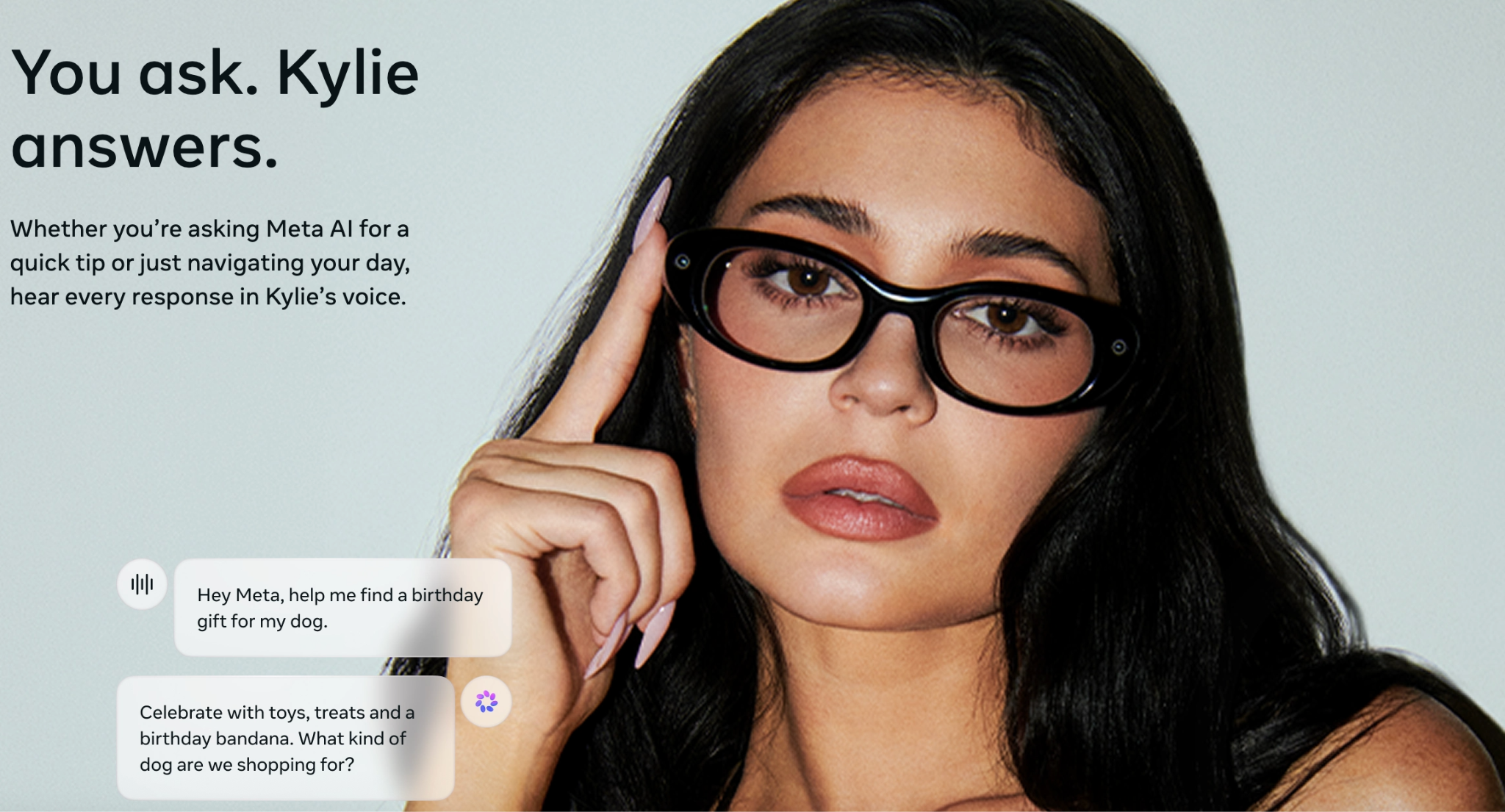
Gucci and Google plan a luxury pair next year. When I saw the announcement, I wondered whether this was the start of an AI elite, with the glasses as the status symbol. Because it will come with a price ladder, and the divide will never be as simple as users against those who refuse. Some will prompt it. Some will date through it. Some will wear it on their face as a flex. Some will hear it hum through the wall. And some will spit the word slop at all of the above.
The easy assumption is that this looks like 2016, red against blue. But Pew Research found Republicans and Democrats now essentially tied in their concern about AI, 50 and 51%. Women view AI unfavorably by 10 points while men favor it by 16. Among adults under 35, net favorability sits at minus 44. Black adults view AI favorably by 29 points, the most of any group measured, while white adults tilt slightly against. Black Americans are the group most likely to be falsely flagged by AI detectors at school and among the most likely to live beside the hum, and we lean toward the technology anyway. Maybe because we have never had the luxury of waiting for a tool to be perfect before using it to get ahead. And up close, a lot of that use looks like necessity: job postings that list the skill as required and schools assigning work that assumes access.
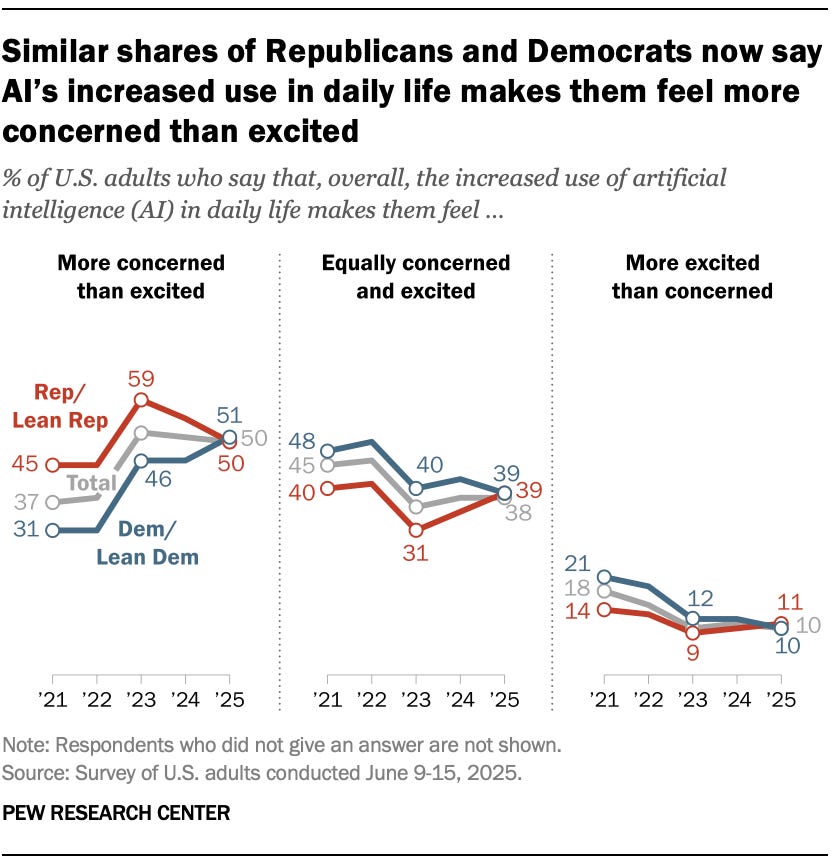
This wedge will run through communities instead of between them. Half the country already believes AI will worsen our ability to form meaningful relationships. Pollsters have started reaching for a term: AI populism. In 2016 the fight was across the fence. This one is coming across the table.
I should tell you where I sit, since the whole point is that everyone will be asked. I left social media years ago, so the factions reach me through comment sections and group chats. Nobody has asked me yet. I build with AI. For a year I published a newsletter hosted by an AI character I created, and I wrote the rules of that arrangement in public, what the machine could do, what only I could do, and when it would end.

I don’t know what I’ll say the first time someone I love tells me my work is slop, or the first time someone I love outsources an apology to a machine and I can hear it. The man in Dowagiac pointed his meter at the sky and got a number, but that was the easy part. The question of the last decade was who did you vote for. The new one is do you use AI. Underneath that question sits the one nobody’s polling yet: What are we willing to do to each other over the answer? ⁂

