Exeunt Omnes
Shakespeare inside a Kentucky prison, telecom companies profiting from incarcerated families, Byron Allen buying BuzzFeed, and the war is punishing the people furthest from the fight.


A KY Program Teaches Shakespeare to Incarcerated Men.
Giselle Rhoden, Louisville Public Media
I just finished rewatching HBO’s Oz for the first time since it went off the air. In Season 6, the final season, the inmates stage a production of Macbeth. The series finale is literally titled “Exeunt Omnes,” which is stage direction for all actors to exit the stage. In the show, the prison gets contaminated and everyone has to leave.
I thought the Shakespeare-in-prison storyline was ahead of its time. Then I read this piece and learned the real version started in 1995, two years before Oz even premiered.
Shakespeare Behind Bars has been running at Luther Luckett Correctional Complex in La Grange, Kentucky, for 31 seasons. This year, 22 incarcerated men performed The Tempest in the prison chapel wearing Elizabethan costumes over khaki jumpsuits, their prison numbers visible underneath. One man, J.S., learned 546 lines as Prospero. During the final monologue, he stripped off his costume piece by piece, pulled out his prison badge, clipped it back to his jumpsuit, and asked the audience for forgiveness. Not as Prospero, but as himself, according to Giselle’s reporting.
The statewide recidivism rate in Kentucky is 30%. Among Shakespeare Behind Bars alumni, it’s 6%.

Prison Telecom Companies Rake in Billions Exploiting Incarcerated People. They Donate a Fraction of Profits to Those They Harm.
Tatiana Walk-Morris, Prism
Two of the largest prison telecom companies, ViaPath and Aventiv, make their money charging incarcerated people and their families for phone calls, video visits, and digital messages. In one year, Aventiv’s subsidiary Securus paid Texas more than $29 million in commissions from those services. That is how much the state earned for giving the company access to a captive customer base.
Then ViaPath set up a foundation and started giving grants to charities serving the same communities the company profits from. Foster care groups. Youth mentoring programs. Scholarship funds for children whose parents are behind bars. More than $400,000 to over 30 organizations. Some nonprofits said they didn’t know about the controversy. Others said the funding helped them do work they couldn’t otherwise afford. Both companies are now pushing the FCC to raise the caps on what they can charge, and the Biden-era rules that brought those caps down have already been reversed under Trump.

Byron Allen Buys BuzzFeed
Variety
BuzzFeed launched in 2006 as a viral content lab. It built BuzzFeed News into a legitimate newsroom, earned a Pulitzer finalist nod, broke real stories, and hired real journalists. Then it gutted the newsroom. Laid off hundreds. Shut down BuzzFeed News entirely in 2023. Pivoted to AI-generated content. Watched the stock collapse from $10 to 73 cents a share.
Now Byron Allen, the Detroit-born media entrepreneur who owns The Weather Channel and a portfolio of local broadcast stations, is buying a 52% majority stake for $120 million at $3 a share. He becomes chairman and CEO. Jonah Peretti, the co-founder, moves to a newly created role called “President of BuzzFeed AI.”
A Black man is inheriting a media company that burned through its credibility, its staff, and its editorial purpose on the way down. What he’s actually buying is the brand, the audience data, and the infrastructure. What he does with it is the question. And the fact that the founder’s new title has “AI” in it tells you everything about what the company thinks is left.

The Iran War Oil Shock Will Hit the Hungry Hardest
Center for Global Development
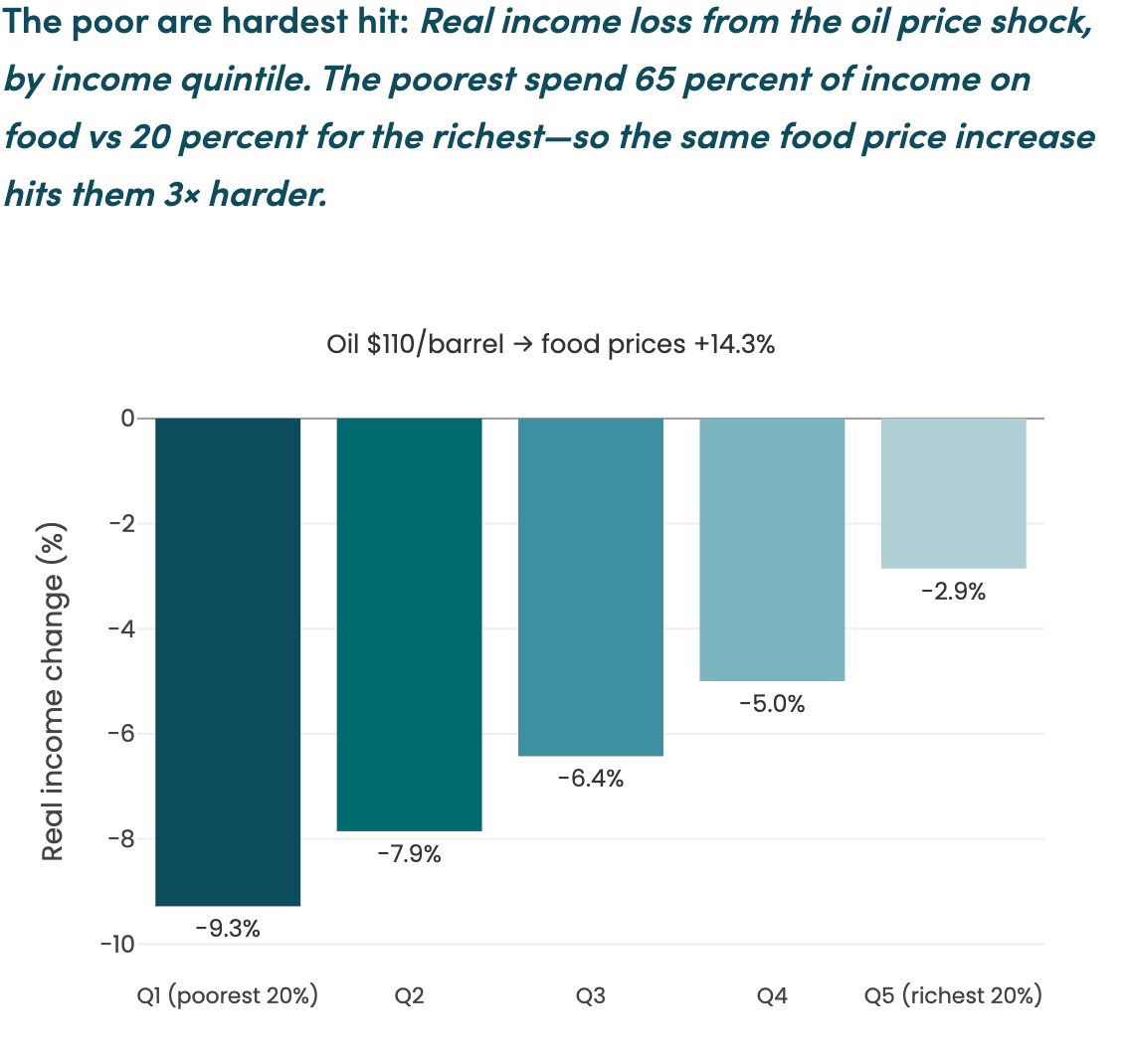
Most of the conversation about the Iran war and oil prices has centered on what Americans are paying at the pump and whether their summer flights will get cancelled. Almost nobody is talking about what happens to people who already spend most of their income just to eat.
The Center for Global Development published an analysis that lays it out. In the poorest countries, households spend half to 70% of their earnings on food. With oil around $110 a barrel, food prices have climbed roughly 14% through disrupted supply chains alone. The World Food Programme warns 45 million people could face acute hunger. The UN says more than 32 million could fall back below the poverty line. In the U.S., April inflation hit 3.8%, the steepest in three years. But across the Global South the crisis is far worse. Bangladesh, Zimbabwe, Nigeria, and Pakistan are rationing fuel. Pakistan cut its public sector to a four-day work week and closed universities.
The war is punishing the people furthest from the fight. The global economy runs through a handful of chokepoints, and when those close, the people with the least margin absorb the most damage. That’s not an accident.

Nobody Told Me This
Dana Amihere, AfroLA
Full disclosure: I’m the product lead at AfroLA and helped bring this newsletter to life. But I’m including it here because Dana’s first issue is exactly the kind of writing this roundup exists to surface.
Nobody Told Me This is a new biweekly newsletter for Black women navigating 40 and beyond. Dana is the founder of AfroLA, a nonprofit newsroom in Los Angeles that centers Black communities. This newsletter is the most personal thing she’s ever published. In the first issue, which went out on Mother’s Day, she writes about inheriting the model of motherhood from the women in her lineage, her grandmother’s Sunday dinners, the dishes she tried to dodge, and the table she’s now trying to set in her own home.
She also writes about learning in her twenties that growing a child inside her wasn’t an option. Nearly a decade later, a new specialist told her it was possible but high-risk. She and her husband chose to grow their family through adoption, specifically older Black girls from L.A.’s foster care system. She writes about standing on the shoulders of her mother, her aunties, her grandmothers, and wanting to be a mother and a strong woman like them.
But Dana realized she had already birthed something. AfroLA itself. She grew something where there was nothing, seeded it with the PTO payout from the job she quit, and built the newsroom she never got to work in. Two kinds of inheritance running at the same time. The family kind and the professional kind. Both are labors of love. And as Dana put it, neither is for the faint of heart.

In a City of Big Dreams, Many Young Adults See a Cloudy Future
Troy Closson, The New York Times
A 24-year-old named Soban Ali moved to New York from the D.C. area, got laid off from a federal contractor job during the government shutdown, and has been searching for full-time work ever since. He tracked his applications on a spreadsheet he titled “The Great Job Hunt of 2025.” He sent out roughly 450 of them. Got about 10 interviews. Still no offer. He works part-time at an after-school program for $18 an hour, one dollar above minimum wage, and told the reporter he can barely afford himself, let alone anyone else.
The numbers across the city tell the same story. Postings for entry-level jobs dropped more than 37% between 2022 and 2024. Average student debt for young adults in New York is nearly $38,000. One woman with a finance degree went from working as an analyst at an investment bank to staffing the front desk at a gym. She posted on TikTok asking strangers for job leads.
Another young woman, 22, moved to New York with her cat and a suitcase after failing to find work in Chicago. She applied to more than 1,000 positions. Marketing roles. Trader Joe’s. Starbucks. Nothing came through. She worked as a stripper for a while but business was slow. Eventually she began doing sex work.
In January, I wrote “Why OnlyFans Makes $ense,” an essay about understanding the impulse to opt out of a system that stopped delivering on its promises. In April, I wrote “Salary for Two,” about the math of living alone in a major American city and realizing the numbers only work if there’s someone else on the lease. Both essays were about the distance between the life you were told a salary could buy and the life that salary can actually support. The Times just sent a reporter to document what that distance looks like on the ground in New York.

The American Experiment — Communicator Award Winner + LA Press Club Finalist
INHERITANCE / HEATDRAWN Media
One of our own this week. The American Experiment, published July 4, 2025, won an Award of Distinction at the 32nd Annual Communicator Awards. The following week, the LA Press Club released its finalists for the 68th annual ceremony, and the same essay placed in the final five for Political Commentary alongside work from Truthdig, Truthout, Washington Monthly, and TheWrap. The ceremony is in June.
The essay asked a question that apparently still has legs: Why does America call itself an experiment, and who consented to be tested?
The American Experiment

The metal legs of roughly two dozen chairs scraped against the linoleum in chaotic unison as a classroom of 12- and 13-year-olds rose to face the flag.