Gentrified Shoplifting
The microlooting debate has a bodycam rebuttal, Emma Grede's memoir is dividing women on TikTok, and the Strait of Hormuz is coming for your summer.


‘The Rich Don't Play by the Rules. So Why Should I?’
The New York Times
The New York Times ran an opinion segment this week with Jia Tolentino and Hasan Piker debating whether stealing from Whole Foods is a form of political protest. Tolentino admitted to stealing lemons while shopping for an elderly neighbor and didn’t feel bad about it. Piker said he supports it philosophically but doesn’t do it personally. They talked about the Luigi Mangione case. They talked about wage theft. They talked about how the social contract is broken because the rich don’t follow the rules they wrote.
I read through some of the more than 1,500 comments. The most popular responses, by a wide margin, were some version of: stealing is wrong, two wrongs don’t make a right, and these are privileged people cosplaying resistance. One commenter called it “gentrified shoplifting.” Another pointed out it’s easy to debate the ethics of theft when you’re white and the worst consequence is a conversation. For Black people, the consequence is a bodycam.
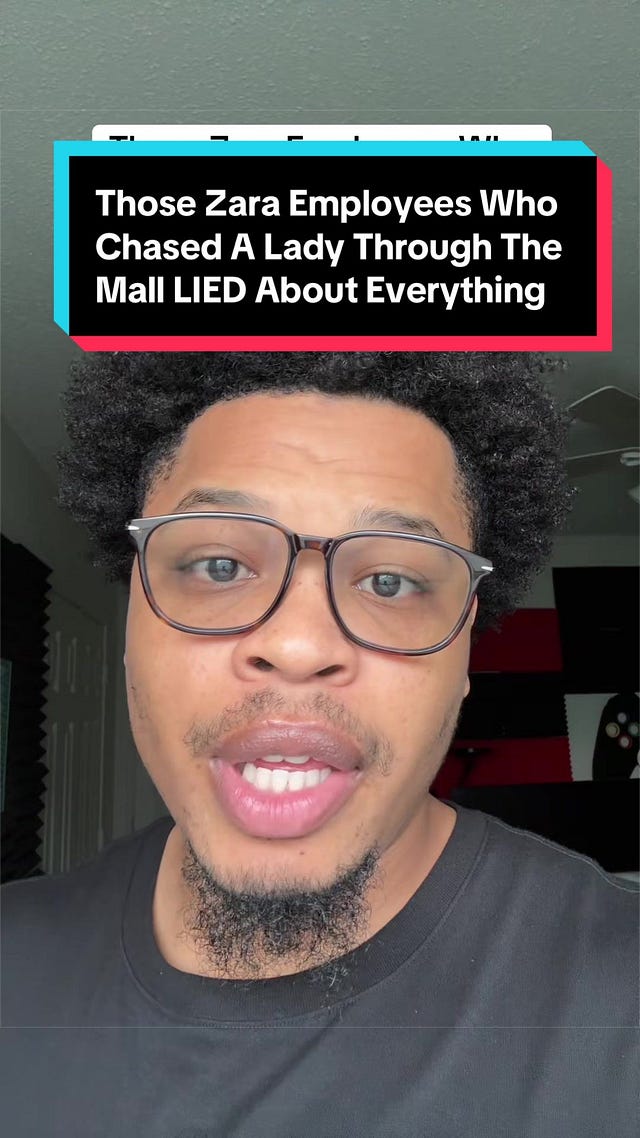
The same week this segment aired, a Black woman named Douniya was chased through a mall in Lynwood, Washington, by multiple Zara employees who were convinced she’d stolen merchandise. They grabbed her. They followed her to her car. They surrounded her vehicle. Police searched her car and found nothing. The bodycam footage shows the employees changing their story in real time. The responding officer told her it wasn’t the first time he’d been called to that store for the same thing. She wrote on TikTok: “There wasn’t a single employee there when I needed help. But they all came out of the woodwork when they thought a Black woman stole.”
Meanwhile, Noah Hawley (the creator of Fargo) published a piece in The Atlantic about attending Jeff Bezos’s private retreat called Campfire. His observation after a weekend among the richest people on Earth was they have “clearly left the world of consequences behind. Their actions are only ever judged by themselves.”
Three stories. One about the privilege of debating whether theft is protest. One about what happens when you’re Black and someone decides you look like a thief. And one about the people who left the entire conversation behind because the rules stopped applying to them a long time ago.
I’m a Black man. I don’t need a podcast to tell me which side of this I’d be on.
 Tiktok failed to load.
Enable 3rd party cookies or use another browser

Emma Grede’s Start With Yourself
Ebony Magazine
Emma Grede is the CEO of Good American, a founding partner of SKIMS, a guest shark on Shark Tank, and now an author. Her memoir Start With Yourself came out last week and the internet has not stopped arguing about it since. The fight is mostly about one comment describing herself as a “3-hour mom,” meaning she gives her four children three hours of fully dedicated time on weekends rather than hovering over every moment of their lives.
Women on TikTok responded immediately. The critique isn’t really about parenting philosophy. It’s about who gets to talk about ambition as a choice when Black mothers have historically had no choice but to work and parent simultaneously — not because of a philosophy, but because of systems that were never designed to support them. Grede grew up in East London, built a career in fashion, and co-founded two of the most visible consumer brands in the world alongside the Kardashians. She is genuinely self-made in ways that matter. But the conversation her book is sparking is less about her and more about who inherits the right to redefine what success looks like as a mother, and whose version of that redefinition gets treated as aspirational versus irresponsible.

Our Longing for Inconvenience
Hanif Abdurraqib, The New Yorker
I started buying vinyl again a couple of years ago. Not because I’m nostalgic for the format. Because I realized the music I was paying for on streaming platforms wasn’t actually mine. Beyonce’s Cowboy Carter and Renaissance — I bought both on vinyl because Apple can block you from accessing music you purchased if you don’t pay for something else they offer, like iCloud storage. Streamers pull albums without warning. Licenses expire. The thing you paid for can be revoked by the company that sold it to you.
Abdurraqib’s essay is about this exact instinct, but broader. He writes about the longing for Walkmans, VCRs, and physical media not because the technology was better, but because it required something from you. Inconvenience was the cost of ownership. The modern world has optimized so much friction out of daily life that we’ve lost the capacity to tolerate it. And what we call nostalgia might actually be grief for a relationship to time and attention and possession that convenience destroyed.

Fuel Shortage Wreaks Havoc on Summer Air Travel
The Washington Post
My birthday is in July. I’ve been thinking about whether I’ll be able to get where I’m going. Then I felt embarrassed for thinking about it that way, because the fuel crisis connected to the Strait of Hormuz closure is about much more than whether my flight gets cancelled.
The Strait has been closed or severely disrupted for nearly two months. The IEA says Europe has maybe six weeks of jet fuel left. United has cut its planned schedule by 5%. Delta is looking at an extra $2 billion in fuel costs this year. KLM cut 160 flights. Oil is above $100 a barrel. The IMF downgraded global growth to 3.1% and warned that a prolonged conflict could bring it to 2%, which would be a near-miss for a global recession and something that’s happened only four times since 1980.
I’m turning 44 this year. I’ve lived through enough of these cycles to know the crisis hits, the prices rise, the recovery is uneven, and the people who were already stretched thin get stretched thinner. The inherited infrastructure everyone depends on (cheap fuel, open shipping lanes, affordable flights) was never as stable as it felt. It just felt stable because the consequences of its collapse were always somewhere else. Until they weren’t.

There’s Another Reason Gen Z Can’t Find Work
Jessica Grose, The New York Times
A new working paper from three economists analyzed 40 years of federal employment data and found that employed workers today are about half as likely to receive a competitive outside offer as they were in the 1980s. The job ladder — the mechanism that lets people move up by moving between companies — has been breaking for four decades. There are two reasons. Employer concentration and noncompete agreements that courts started enforcing more aggressively in the 1980s. Thirty-eight percent of workers have been subject to a noncompete at some point, including hourly and part-time employees who had no idea what they were signing.
I’m a millennial. I’ve been running the same math the economists are describing. I look at a salary attached to a major city and realizing the numbers only work if there’s someone else on the lease (more on this Monday!). Gen Z didn’t inherit a broken ladder. They inherited the debris of one that started breaking before they were born. The difference is they’re entering the workforce knowing what took some of us a decade to figure out.

Work for Food: New SNAP Rules Reshaping Who Gets to Eat
Krystal Nurse, Straight Arrow News
Clifford Glenn is 60 years old and lives in Pontiac, Michigan. Every week he walks to a church for a hot meal and groceries, keeps some for himself, and brings the rest to an elderly neighbor whose house he also cleans. Under new federal rules, Glenn has to work or volunteer 80 hours a month to keep his food stamps. He says he spends more than 80 hours a month walking around Pontiac looking for work.
The Congressional Budget Office estimates 2.4 million people will lose benefits. Glenn is classified as an “able-bodied adult without dependents,” which sounds clinical until you learn the definition: single, no children under 14, living in an area with unemployment below 10%. Pontiac’s unemployment is 8.6% — just under the threshold. The city lost its identity when the factories closed and never fully rebuilt it. The inherited belief underneath these rules is that hunger is a motivation problem. Glenn is already motivated. He’s feeding his neighbor.

Fortress Yellowstone
Joseph Bullington, In These Times
The ultra-rich are buying up land inside and around one of America’s last intact ecosystems. Yellowstone and the Greater Yellowstone area — the largest nearly intact temperate ecosystem in the world — are being fortified by people whose wealth was extracted from what the writer calls ecological sacrifice zones through mining operations, deforestation, industrial extraction in other landscapes, other countries, and other people’s land. The money that damaged one part of the earth is being used to own and protect another part of it.
This is an inheritance story told through geography. Who gets to inherit the earth is not a metaphor here. It’s a deed. The people with the resources to buy the last unspoiled places are the same people whose industries made the rest of the world worse. And the land they’re buying was never theirs to begin with. It belonged to the Indigenous nations who were removed so it could become a national park in the first place. One inheritance layered on top of another.