

Lego Videos From the Revolutionary Guard
A regime that would execute me is speaking to my community through my own culture. An algorithm made the introduction.

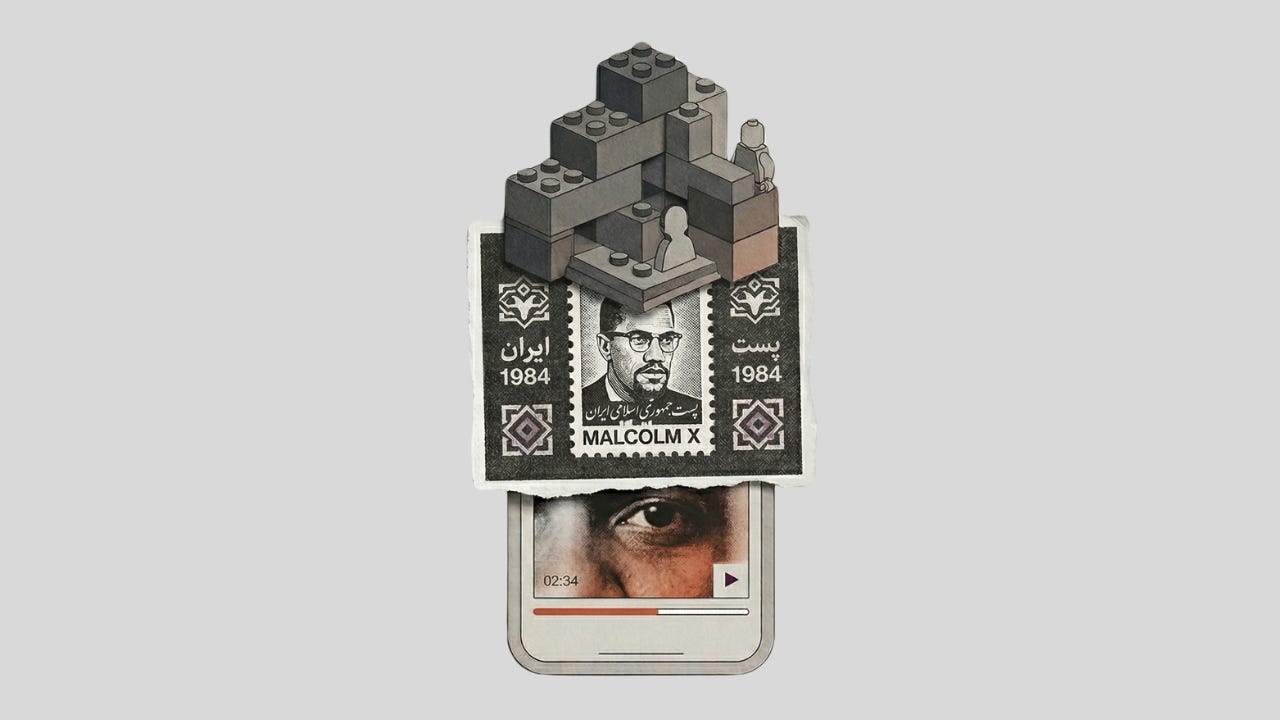
I was lying in bed when Iran found me.
Not Iran the country. Not a diplomat or a broadcast or a press release. A Lego cartoon. Two animated figures, one in a suit meant to be Donald Trump, the other shaped like Benjamin Netanyahu, both rendered in bright plastic blocks and filmed like a stop-motion toy commercial. The video was absurd. It was also, I would learn later, produced by a media institute linked to the Islamic Revolutionary Guard Corps. TikTok served it to me between a cooking video and a clip of someone’s cat twerking.
I didn’t search for it. I hadn’t typed “Iran” into anything. I hadn’t followed any accounts connected to the war. But over the next several weeks, my feed shifted. More Lego videos. Then AI-generated footage of buildings collapsing that I couldn’t verify. Then clips of Black creators addressing Iran directly, telling the country they had no quarrel with it. One, from content creator Jamila Bell, has been viewed more than four million times.
I watched it arrive in my feed and recognized what was happening. And it’s not because I’m unusually perceptive.

At University College Dublin, I studied how TikTok’s algorithm shapes visibility for Black LGBTQ+ creators. Two-thirds of the people I interviewed believed their content was being suppressed. One creator told me certain topics were “too Black for the algorithm.” The platform’s recommendations don’t distinguish between a fashion video and a political argument. It measures engagement, amplifies what resonates, and serves it to the people most likely to respond.
I wrote my thesis about what that design does to creators. Now I was watching the same design do something to me.
The algorithm hadn’t been hacked or manipulated. It was doing exactly what it was built to do: find the people most likely to react to content about race, identity, and American foreign policy, and putting that content in front of them. A study in War on the Rocks surveyed 193 college-aged TikTok users and found that the platform doesn’t change what people believe. It changes how they feel. Feeds become emotionally uniform even when users aren’t looking for reinforcement. The platform doesn’t need to convert anyone. It just needs engagement.
The International Institute for Counter-Terrorism identified five categories of AI-generated content from pro-Iranian accounts, including fabricated footage and fake claims reinforced with synthetic evidence. The Lego format was deliberate. TikTok’s moderation catches violent imagery, but toy animations read as playful. One video reached millions of views before it was flagged. Meanwhile, the White House posted videos to X and TikTok mixing real strike footage with clips from Call of Duty, Iron Man, and Top Gun.
Both governments are using the same platforms to shape perception. The difference is in who the message reaches and why it lands.
During the 1979 hostage crisis, Ayatollah Ruhollah Khomeini ordered the release of 13 hostages, all women or African Americans. The message was explicit. Black Americans were already oppressed by their own government. In 1984, Iran issued a postage stamp honoring Malcolm X. In the 1970s, Iranian student revolutionaries collaborated with the Black Panther Party. In 2020, Iran’s Supreme Leader criticized the treatment of Black Americans during the George Floyd protests.
A viral claim has been circulating on TikTok that Iran has said it does not want to hurt Black people. Word In Black investigated and found no verified current statement from the Iranian government to support it. But they traced what the claim draws on, and the list above is what they found.
The claim is not Iranian government policy. It is a myth built on a factual foundation. The fabricated strike footage is designed to deceive. The historical references are documented facts. The creator videos are genuine expressions. They are all in the same feed.
I know why it resonates. I grew up in a country where the question of who is protected has never had a simple answer for Black people. DOD demographics data analyzed by the Carnegie Endowment shows Black Americans make up roughly 19% of active-duty military enlistments despite being about 13.7% of the population. A YouGov/Economist poll conducted shortly after the U.S.-Israeli strikes began found that only 7% of Black respondents supported the bombing, with 66% opposed. Republican voters, in a separate Quinnipiac survey, supported the military action at 85%.
Word In Black published a piece titled “We Bombed Iran. Black Folks Are Asking: Who Is ‘We’?” That question is the inherited contract because the word “we” assumes a collective decision. It assumes that American citizenship means American foreign policy is yours, that the military acts on your behalf, that the country’s wars are your wars. Black Americans have been disproportionately enlisted in those wars while simultaneously being told our own domestic safety isn’t a guarantee.

At USC Annenberg, I studied how governments try to influence communities in other countries. My graduate thesis explored how the U.S. State Department advanced LGBTQ+ human rights abroad under three administrations. The most effective case I documented worked because it was grounded in something real like a former consulate general in Japan, openly gay and partnered, who used his own visibility as the message. The least effective cases collapsed when domestic credibility disappeared, as it did when the Trump administration rolled back LGBTQ+ protections at home while the State Department was supposed to advocate for them abroad.
Iran’s approach toward Black Americans follows the same logic, aimed in the opposite direction. The United States has historically tried to win over specific communities in other countries. Iran is doing the reverse by reaching a specific community inside the United States, through a channel that didn’t exist when the textbooks on this subject were written.
Black American culture has been this country’s most underrated export for decades. Jazz during the Cold War. Hip hop globally. Black athletes and entertainers as cultural ambassadors. The United States has benefited from Black cultural influence abroad without ever formally investing in it as a strategic asset. Now a foreign government is using that same influence not to promote America, but to undermine it.
The strategy is to find a shared grievance, point it at a common target, and build sympathy with people who already have reasons to distrust that target. Iran does not need Black Americans to support the Islamic Republic. It needs them not to support the war. And on that narrow objective, the message arrived at an audience that was already there.
Not everyone received it the same way. Other Black creators pushed back, calling Iran’s use of Black music, Black symbols, and Black history a form of exploitation by borrowing from Black resistance culture while ignoring the Afro-Iranian community within its own borders.
I need to say this part clearly, because my thoughts above could be read as sympathy for a government that would kill me.
Iran executed over 2,000 people in 2025, the highest number in more than 30 years. It sentences LGBTQ+ people to death under its penal code. A UN Fact-Finding Mission documented mass killings of protesters, enforced disappearances, and the deportation of LGBTQ+ people to Afghanistan. As a gay Black man, I am under no illusions about what this regime represents.
But analyzing how a government’s strategy works is not the same as endorsing the government that runs it. I shouldn’t have to write that sentence, but I do, because the inherited assumption in American public discourse is that explaining why an adversary’s message lands means you’ve been taken in by it. That assumption makes us worse at responding. And right now, the United States is not countering it. Sixty-one percent of Americans disapprove of Trump’s handling of the conflict. Germany’s defense minister said, “This is not our war.” The UK, France, Italy, and other NATO allies declined to join a U.S.-led naval coalition to reopen the Strait of Hormuz.
During the Cold War, states built entire broadcasting infrastructures to reach foreign audiences like Radio Free Europe, Voice of America, and the BBC World Service. In 2026, a state-run institute produces a Lego cartoon, uploads it, and lets the platform do the distribution.
Platforms make no distinction between fabrication, fact, and genuine expression. It treats them all the same: content that generates engagement, served to the people most likely to respond.
The inherited assumption is that someone else will sort it out. That someone will moderate. That the government will counter. That the user is in control.
The question people keep asking is why Iran’s message is getting through. That’s the wrong question. The question is why ours isn’t. And the answer is an inheritance too. A country that has never fully made its case to the people it claims to speak for is now discovering that someone else is making it for them. ⁂

