Mr. Explosive
Iran's propaganda in Lego, a CEO's manifesto for firing 4,000 people, and why tax season was designed to stay miserable.


We Spoke to the Man Making Viral Lego-Style AI Videos for Iran
BBC/Top Comment podcast
I’m writing about this on Monday, so I’ll keep this short here. The BBC’s new podcast interviewed the person behind Explosive Media, the outfit producing those AI-generated Lego-style propaganda clips about the Iran war. He calls himself Mr Explosive. He initially denied working for the Iranian government, then admitted under questioning that the regime is a “customer.” His team is fewer than 10 people. They use the Lego aesthetic because, he says, it’s “a world language.” He appeared on the video call flanked by the colors of the Iranian flag with a green-feathered helmet on his desk.
I was surprised by his candor. He wasn’t hiding behind PR language or plausible deniability. He just said this is what we do, this is who pays for it, and we think it’s honorable. Most propaganda tries to obscure its own origins. This guy sat for a BBC interview and explained the business model.
What makes the Iranian government’s media strategy even more interesting is that it’s running in two directions at once. Outward, Lego for global audiences. Inward, something completely different. Yeganeh Torbati, a reporter whose book on post-revolutionary Iran comes out in June, wrote about how the regime has started reaching back into the country’s ancient, pre-Islamic past to shore up nationalist support. The same pre-Islamic history the Islamic Republic spent decades rejecting. As one historian told her, the turn is a tacit admission that “the ideology of Islamic revolution has failed.” A government raiding an inheritance it once tried to erase.

The TurboTax Trap
ProPublica
Tax day just passed and if you felt the familiar dread, this is why. ProPublica investigated 20 years of lobbying by Intuit, the company behind TurboTax, to make sure the U.S. government never built a free tax filing system. Most wealthy countries did this a long time ago. America didn’t, and it wasn’t an accident. Intuit hired former IRS officials, funded op-eds through minority advocacy groups, got Congress to pass a single sentence barring the IRS from spending any money on a public filing option, and designed its own “free” product with dark patterns that push users into paying once they’re too deep in the process to start over. Internal documents show the company knew its customers were confused and angry. One TurboTax rep told a caller that the “free free free” ad campaign had been “the bane of my existence.”
Americans spend 1.7 billion hours and $31 billion doing their taxes every year. That number was engineered. The inherited belief that taxes are supposed to be complicated isn’t a natural condition. It’s a business model someone spent two decades protecting.

From Hierarchy to Intelligence
Jack Dorsey and Roelof Botha / Block and Sequoia Capital
In February, Block CEO Jack Dorsey fired approximately 4,000 employees, about 40% of the company’s workforce, while reporting record gross profit. Then on March 31 he and his lead investor published this essay explaining why. The argument: corporate hierarchy is a 2,000-year-old information routing system inherited from the Roman Army, and AI has made it obsolete. Managers exist to relay information up and down the chain. AI can do that now. So the people who were the routing layer are no longer needed.
I’ve been writing about this pattern on my AI Governance Briefing for weeks. OpenAI is paying freelancers through a program called Stagecraft to document their own jobs so AI can learn to replace them. Oracle cut 30,000 workers to fund data center construction. The market keeps rewarding whoever frames layoffs as vision — Block’s stock jumped 24% after the cuts. The same week Dorsey published this manifesto, Anthropic refused a Pentagon contract over safety concerns and got blacklisted. OpenAI signed a Pentagon deal hours later and its valuation rose $110 billion.
The essay is worth reading because Dorsey is saying the quiet part with footnotes. Most CEOs wrap layoff memos in empathy. This one wrapped his in Roman military history and published it with his investor.

Patrick Radden Keefe’s London Falling
The New Yorker
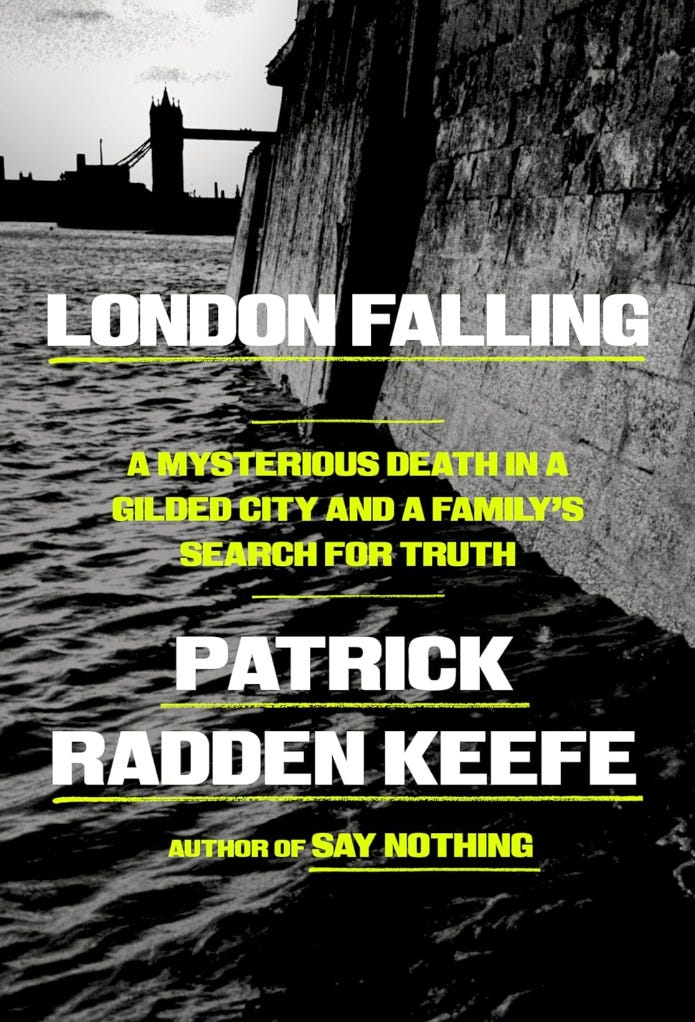
I hadn’t heard of this story before this week. In 2019, a 19-year-old named Zac Brettler fell to his death from a fifth-floor luxury apartment overlooking the Thames. He was the grandson of a well-known London rabbi, grew up middle-class, went to a good school. After he died, his parents discovered he’d been living a second life under a different name, posing as the son of a Russian oligarch, claiming he was set to inherit $270 million. The apartment belonged to a violent gangster. The police called it suicide. His parents don’t believe that.
The first thing I thought of was Anna Delvey. I’m sure you remember the woman who pretended to be a German heiress and scammed New York’s elite. You can watch the trailer for the Netflix show made about her here. And then the movie Saltburn, which is basically the fictional version. All three are stories about people who absorbed the language of wealth, learned the costume, and tried to wear it. The difference is Brettler was 19 and didn’t survive it. Keefe, the journalist behind Say Nothing and Empire of Pain, uses the death to examine what London’s money culture makes available to anyone willing to perform it, and what happens when the performance meets someone who isn’t performing.

Disney Begins 1,000 Job Cuts This Week Across the Company
Meg James, Los Angeles Times
I moved to Los Angeles to be an actor. I spent the first four years in that city trying to figure out if the thing I thought I wanted was actually mine or something I inherited from watching too many movies as a kid. I left because I realized I wasn’t passionate about being in front of the camera. But I still love the craft. I love going to the movies. I love what it takes to build a world on screen that an audience believes in.
Marvel’s visual development team was gutted this week. These are the artists, illustrators, character designers, and environment designers who built the look of the MCU for over a decade — the Avengers, Guardians of the Galaxy, Black Panther. Many had been there ten years or more. Nearly the entire team was let go. A skeleton crew stays to hire contractors on a per-project basis.
When I think about Black Panther and what Wakanda meant to people, I think about the fact that someone had to build that world before anyone could see it. A team of artists sat in a room and designed a place that didn’t exist, and it mattered to millions of people in a way that went beyond a movie. Those people are now being told their work will be done by freelancers assembled when someone decides a project is worth it. Which means someone gets to decide which worlds are worth building.


The Absolute Hell of Watching a Movie at the Alamo Drafthouse in 2026
David Ehrlich, IndieWire
I used to walk to the Alamo Drafthouse in downtown LA from my apartment. Great vibes. Great drinks. Great seats. The whole point of the place was that someone cared about the experience of watching a movie. The screens, the sound, and the respect for the audience. David Ehrlich’s piece is about what the Alamo has become after being acquired and optimized: QR code menus, aggressive upselling, a customer experience he compares to air travel. An institution built on loving movies, turned into a delivery system for snacks at the push of a button. If you ever loved going to the Alamo, this one stings. Some people probably love it now. That might be worse.