

The No Emergency Contact Crowd
A storage company wanted an emergency contact. I gave them one. It was me.

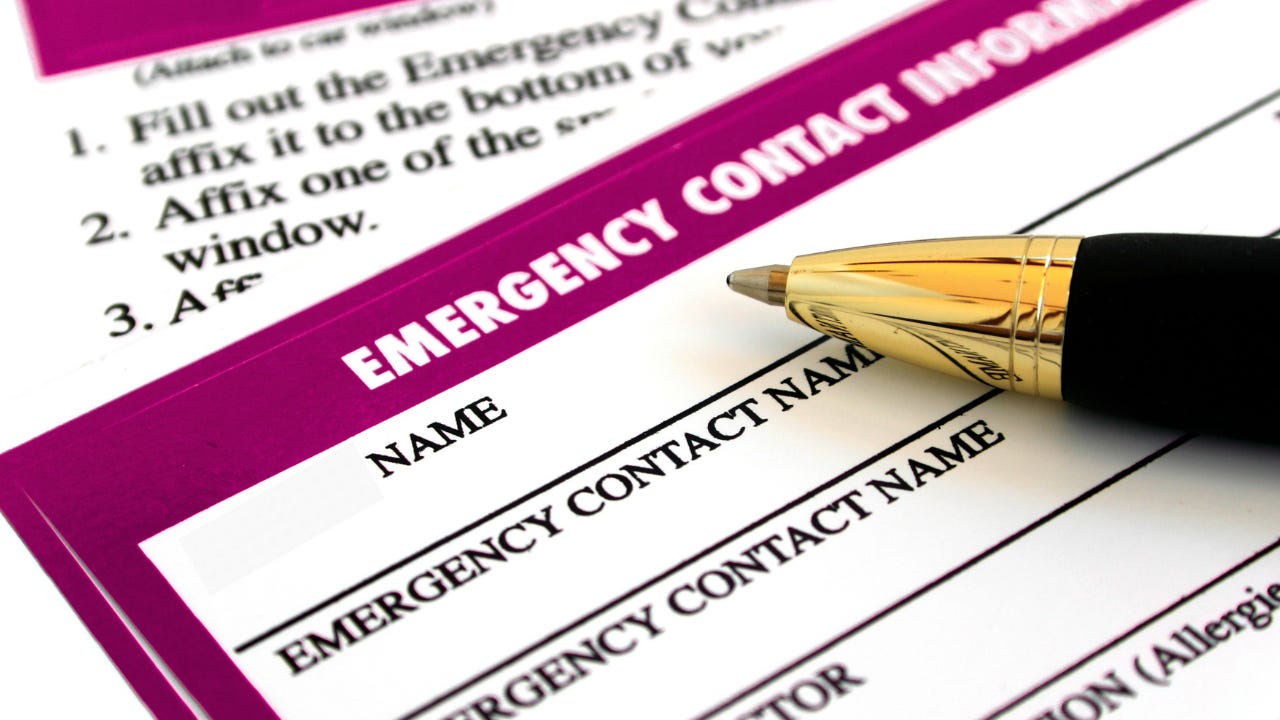
The email came from a self-storage company. Not a hospital, not an embassy, not anyone with a plausible claim on my mortality. I read it in Paris, on my iPhone, and it ran four lines. Following a review of my file, it said, they needed information: Un numéro d’urgence (personne de confiance, numéro différent du votre). An emergency number. A trusted person. A number different from mine.
A company that rents me a locked room for boxes on the northeast edge of Paris, wanted, with some insistence, the name and phone number of a third party they could call in an emergency. I had to run the email through a translator to be sure I was reading it right. I still don’t know what the review of my file turned up, or whether there had been one.
I did what people like me do. I read the terms. I looked for the law they were leaning on and could find no French statute requiring a self-storage customer to provide an emergency contact; the company appeared to be relying on its own general conditions, a contract wearing the costume of a legal obligation. I drafted a reply pointing out the obvious: If there is ever an emergency involving my unit, I am the person to call. I am the one who knows what’s inside. I am the one who lives here. I remain, as I put it to them, la personne la plus appropriée à contacter en priorité.
What annoyed me wasn’t the request. It was the assumption underneath it. That everyone, everywhere, has a person. A default human. Someone whose name comes to you without hesitation, who has implicitly agreed to be summoned on your behalf, whose existence is so universal that institutions feel entitled to make them a condition of doing business with you.
The storage company was only the latest to ask. The dentist asks. The gym waiver asks. Every onboarding packet at every job asks. If you have a person, the question takes five seconds. If you don’t, it follows you from form to form. The no emergency contact crowd will never be understood by the people who have one.
Next of none
Researchers have a word for people without close family ties: kinless. In the Health and Retirement Study, the long-running national survey of older Americans, 6.6% of adults 55 and above had no living spouse and no biological children. About 1% had no partner, no children, no siblings and no parents at all. The sociologists Rachel Margolis and Ashton Verdery published those figures in 2017, and both have been climbing with each birth cohort since, pushed by declining marriage, rising childlessness and divorce after 50. Running the numbers forward, they wrote that they expect “dramatic growth in the size of the kinless population.”
Researchers at the Icahn School of Medicine at Mount Sinai, went at the same national data from the other end and counted the dying. Among decedents, 7.9% had neither a spouse nor an adult child — nationally, 1,027,600 older Americans who reach the end of life with no close family at all.
Verdery and Margolis also projected the picture out to 2060, and the burden does not fall evenly. Among white Americans over 50, the share without a partner or biological children stays more or less flat, somewhere around 8 to 10%. Among Black Americans it climbs.
Black men go from 9.7% to 12.6%. Black women from 10.5% to 15.1%.
When you don’t inherit a support network, you build one. Mine is paid for.
Those are American numbers. Denmark has its own. Researchers pulled the civil registry for every adult 60 and older who died of natural causes in the country between 2009 and 2016 — 137,599 people — and matched them against hospital records. The kinless were the least likely group to have visited a hospital, an emergency department or an intensive care unit before they died. The study could not establish why. But it does raise a disturbing possibility: When no relative is present to notice a decline, call for help, or press for treatment, access to care may change.
None of that reaches the form. The field is one line long. It wants a name and a number that isn’t mine.
The people I pay
People without a default person move differently through the world. We are always scanning for safety. Not in a dramatic way — in an administrative way. We keep copies of everything. We know where the exits are, literal and contractual. We learn which documents need an apostille and which don’t, because getting one wrong from thousands of miles away requires the very thing every form assumes you have: another person who can step in.
This month I needed apostilles on two sets of documents: a certified Statement of Information for my company and my graduate transcripts from the University of Southern California. California issues apostilles at two counters. One is in Sacramento. The other is the regional office in downtown Los Angeles, walk-in only, no appointments, where you take a numbered ticket and wait for your number to be called.
I did have someone I could ask. A friend I trust with things like this, and that is its own short list. She said yes and made the first trip.
Then I discovered that I had sent her the wrong document, which was my mistake. Fixing it meant another trip downtown. By then, my transcripts were ready, but USC would not release them without notarizing them first. What had begun as one favor now required two more stops: the university, then the Secretary of State’s office.
When I asked whether she could add the campus stop, she sent a voice note.
She said she was happy to help. She said it several times before explaining that the request had become larger than I seemed to understand.
“It’s not even about the money,” she said. “It’s really just about my time.” There was the traffic, the waiting, the printing and everything involved in getting across Los Angeles. “It’s not a small task, babe,” she said. “It’s a huge task. Do you understand that?”
The hardest part, she said in a second message, had been telling me no. “I was afraid that I was going to disappoint you or that you were going to get upset with me if I said I wasn’t going to be able to do it.” She cared about me and wanted to help. If she were truly my last option, she said, she would go.
She was right. I had sent the wrong document. A favor that began as one trip downtown had grown into an afternoon of errands. Friendship made it possible for me to ask. It did not make her time mine.
I withdrew the request and hired a courier.
I found the company online and told them what I needed. They sent an invoice for $275. I paid it, emailed the document I already had and arranged a time for USC to release the transcripts. The courier collected them from the university, took both sets of documents for apostilles and completed the job in about two hours. No negotiation, and nothing was owed but the fee. It was, honestly, magnificent — and clarifying. This is how you stop wondering whom to call. Not all at once, but one heavy ask at a time.
People without a default person do not simply go without help. We buy infrastructure. The courier is one piece of a network that includes the accountant, the notary, the extra insurance and the service that accepts packages when I can’t. When you don’t inherit a support network, you build one. Mine is paid for. An invoice cannot love you, and that is a real loss. But an invoice does not resent the request or keep score. The terms are explicit, agreed in advance and honored on both sides. That is more than some families can say.
This is the bargain you learn early: Set yourself up financially so you can take care of yourself, because the person you can summon on short notice is often the person you pay.
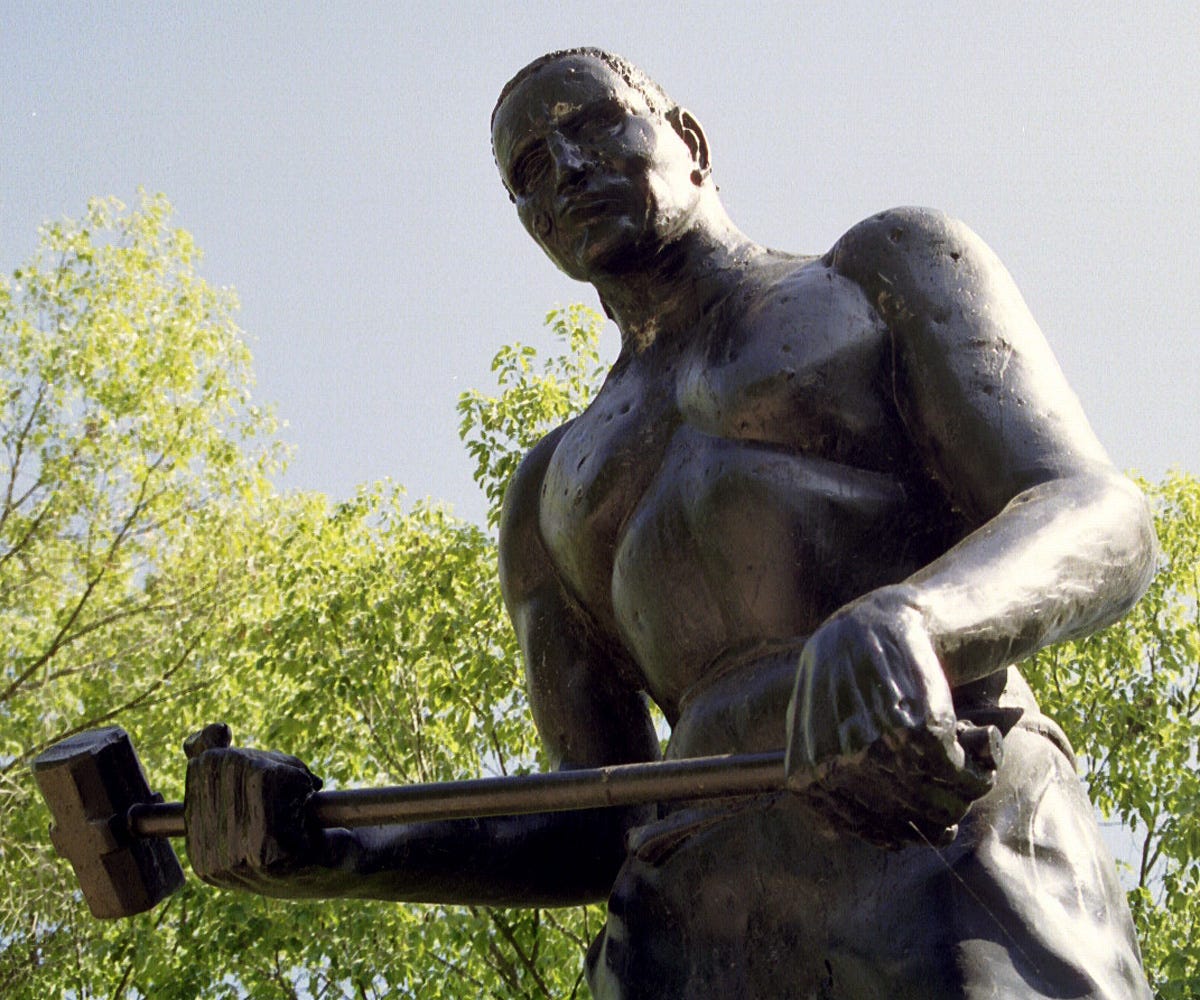
There’s a body of research on what living that way costs. In the 1970s the epidemiologist Sherman James was in eastern North Carolina, interviewing farmers, truckers and laborers about why Black residents there carried so much more hypertension than their white neighbors. One of the men he met was named John Henry Martin. James borrowed the name for the pattern and called it John Henryism, after the steel-driving folk hero who beat the machine and died with the hammer in his hand. He has defined it as a “strong personality disposition to engage in high-effort coping” with social and economic adversity, and he built a 12-question scale to measure it. In the Pitt County Study, he and his colleagues found the highest blood pressure among people who scored high on that scale and had the least education and income. Among high scorers with money and schooling, they found no such effect.
Decades of research since have linked that kind of striving to hypertension, dysregulated stress hormones and cardiovascular strain, and much of it centers on Black Americans, for whom this coping style has been a survival inheritance. The findings cut both ways; high-effort coping can also confer mastery and self-esteem. But the research keeps finding that people who cope this way tend not to ask for help, even when they need it.
In case of emergency, call me
On May 2, 2023, the U.S. surgeon general, Vivek Murthy, released an 81-page advisory declaring loneliness and isolation a public health epidemic. About half of American adults reported measurable loneliness. Lacking social connection, the advisory said, carries a mortality risk comparable to smoking up to 15 cigarettes a day. I’ve built a life I chose, across continents, on my own terms. The country has diagnosed the disconnection. Every form still assumes you have someone.
Here’s what I propose, if anyone with a form to design is listening. “Who is your emergency contact?” is the wrong question. It assumes the answer will be someone I’m related to. What they actually need to know is what to do. Ask instead: How would you like us to reach you, and what should we do if we can’t?
For a storage unit, the honest answer is the customer. For a hospital, it might be a documented health-care proxy, a neighbor, or a friend. The research on kinless adults consistently finds that non-family caregivers step into these roles all the time.
I ended the standoff the way the no emergency contact crowd ends most things. On my own terms. Rather than keep volleying emails across a language barrier, I sent the company what it wanted — a name and a Los Angeles phone number. The name is invented. The number reaches the American line I keep alongside my French one.
They wrote back within the day. My account was complete. I was welcome to forward the exchange to their management if I liked, because cette demande ne relève pas d’une initiative personnelle — the request was not one employee’s idea. The emergency contact is a mandatory contractual field. And then the sentence that explained the whole thing: Le numéro d’urgence ne pouvant être le même que le numéro principal il m’était impossible de renseigner à nouveau celui que vous nous aviez communiqué. The emergency number cannot be the same as the primary number, so it was not possible to enter mine again.
That is the requirement. A second number, unmatched to the first.
Somewhere in their system, a box got checked. Nothing about my situation changed, because nothing about it needed to. I know what’s in the unit. I read the contract. In case of emergency, they’ll reach me.
They just won’t know it. ⁂

