

What Fast Food Hides
In Bali, a green orange, a roadside warung, and a KFC counter changed what I thought I knew about a meal.

The man behind the counter at Arum Coffee took an orange from a basket and I almost told him it wasn’t ripe. The skin was green. Not green at the stem, not green going to gold, but green the whole way around, the color of a lime.
He cut it in half. Inside was the orange I had expected, the segments tight around a white core, a few pale seeds in the flesh. I had been wrong about the outside. In a climate with no cool nights, the chlorophyll in the peel never breaks down, so the fruit ripens all the way through while the skin stays green. The orange was fine. What I had brought with me was the problem.
He laid the halves on a hand press and leaned into it, pressed and turned and pressed again, and the juice ran into a paper cup he capped and handed me.


I had been standing there a while by then.
When I ordered, no one called a number or pointed me to a shelf. Take a seat, they said. We’ll bring it out. I walked down the block to another shop and came back, and the acai bowl I ordered still wasn’t ready. In Los Angeles, a wait like that would have gotten under my skin. I am used to food that is ready before I am.
The counter was not idle. It was moving the whole time, one order at a time, each bowl started only after someone asked for it. They were making it. Behind the counter someone was halving the orange I had nearly sent back, chopping mango, building the bowl by hand. There was no other way it got built. Nothing sat in a cold case for me to point at. The wait was not a failure. The wait was the food being made.

A few months before I stood waiting on that orange, Chris Kempczinski, the chief executive of McDonald’s, filmed himself eating one of his own hamburgers. He posted the video in early February to promote the new Big Arch, a two-patty burger that runs past 1,000 calories. In the clip he never once calls it food. He calls it a product. A delicious product. He takes one small bite and tells the camera he’ll finish it later, off screen.
The internet roasted him for a week, and rival chains filmed their own executives biting into their own burgers to make the point that at least they would. I’m not interested in joining the pile-on. It was the word. Product. It was the honest word, and it came out of him without a fight. He sells a product and he knows it. I had grown up believing food could be that too. Something that arrived. A thing you ordered and received across a counter you never looked behind.
My friend Agus is Balinese and grew up on the island. He gave me his own McDonald’s memory as we passed one while headed to a museum. McDonald’s came to Indonesia in 1991, into a department store in Jakarta. A visit cost more than a meal from a stall, and it carried the shine of somewhere else. By the time it reached Agus as a boy, a few years later, it was still that. An occasion. Something you saved for. The playground. The ball pit. The birthday a cousin’s family drove into town for. You went for the celebration, he said. Not every day. He said it twice, the second time more to himself than to me.
When I asked what made it worth the price, he put it on the ingredients. They were select, he said, and that was what you were paying for.
It was the opposite of what I grew up with. At home the product is the ordinary thing, the food you eat without deciding to, and the made meal is the occasion you save for. Here it was the other way around. The prepared meal was just a regular Tuesday. The product was the party.

Agus had started as my driver. In the first week I told him I didn’t come for the island built for men like me, the one with the pools angled at the rice terraces and the menus in English. A few days later he turned off the main road onto a smaller one and pulled up at a warung he liked.
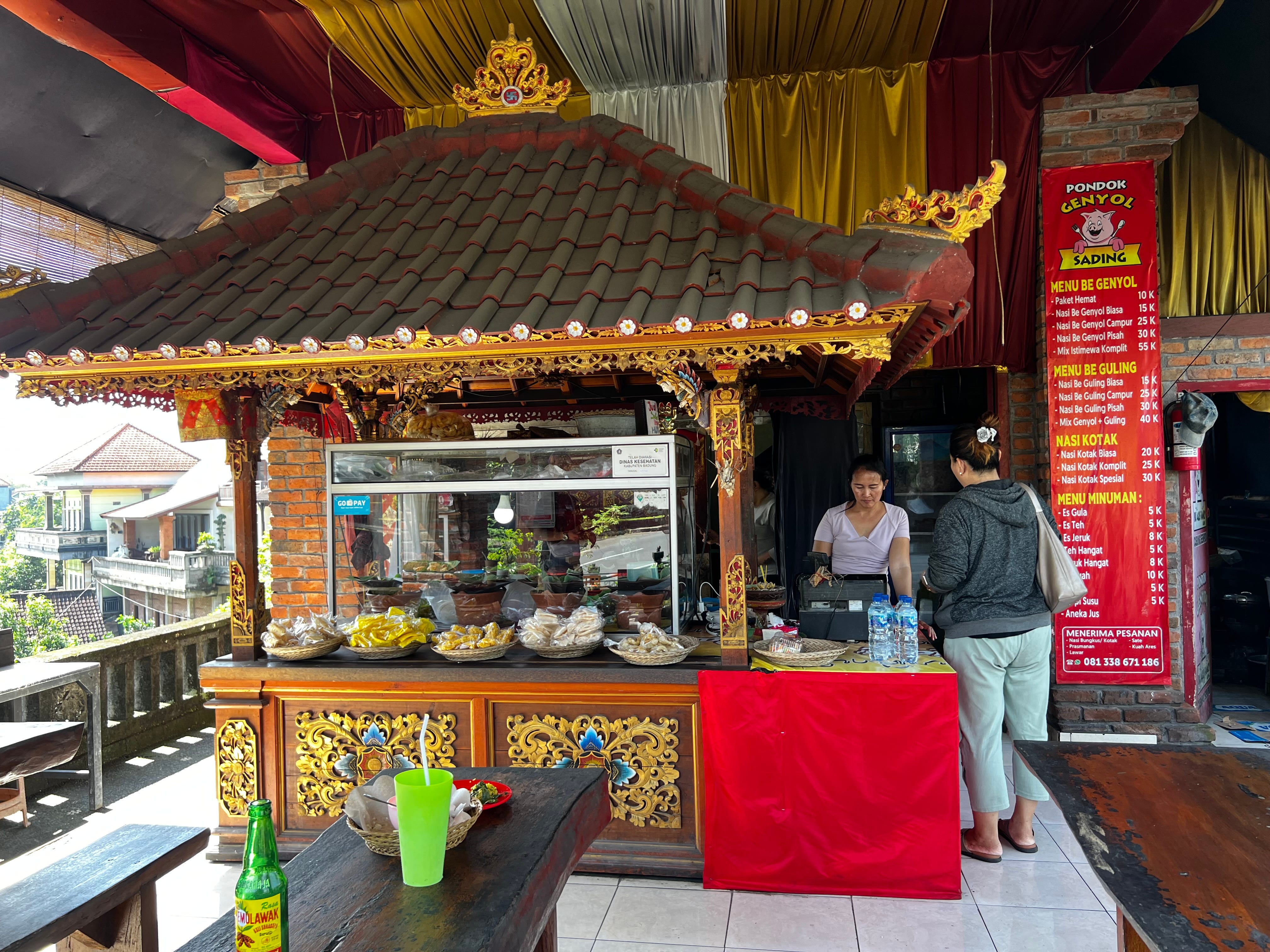
Pondok Genyol Sading is open to the air under a tiled roof. A few wooden benches. A counter carved and painted gold in the shape of a small temple, the day’s food behind glass, a sticker for the payment app stuck to the side.
Agus ordered for both of us without looking at the menu. A full plate of be guling came to 15,000 rupiah, less than a dollar, and reached the bench almost as soon as he asked for it.
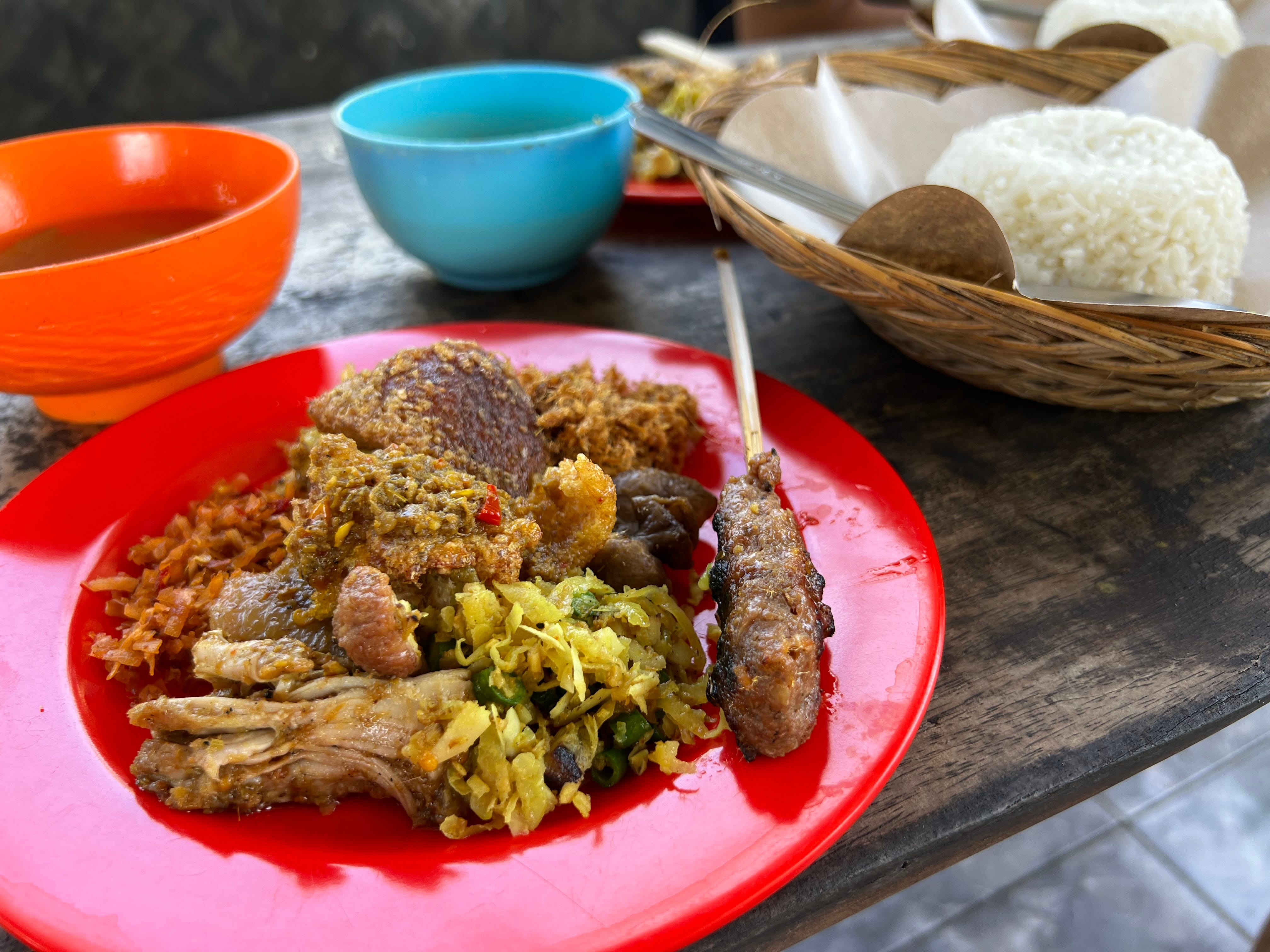
It was a red plastic plate with a little of everything. Shredded pork gone soft in its own fat. Long beans and grated coconut shot through with chili. Minced meat pressed along a flattened stick and grilled until the edges caught. A shard of crackling. A bowl of clear broth, and between us a basket of rice still warm. The grilled stick is sate lilit. The coconut tangle is lawar, and the red lawar, the kind cut with fresh blood, belongs to the temple. The roast pig the plate is built around, babi guling, spent most of its history as something other than lunch. It was made for odalan and for weddings, turned over a fire before dawn by the men of the banjar while the women folded the offerings. A dish you cooked to mark a day.
The plate was fast, but the speed wasn’t in front of me. The pig turned over its fire before light. The rice had steamed. The lawar had been mixed. The broth had simmered. By the time I sat down the work was done and waiting. The plate was quick because the labor had been moved to the front of the day, not because the labor had been removed. I was eating, fast, on a bench, for less than a dollar.
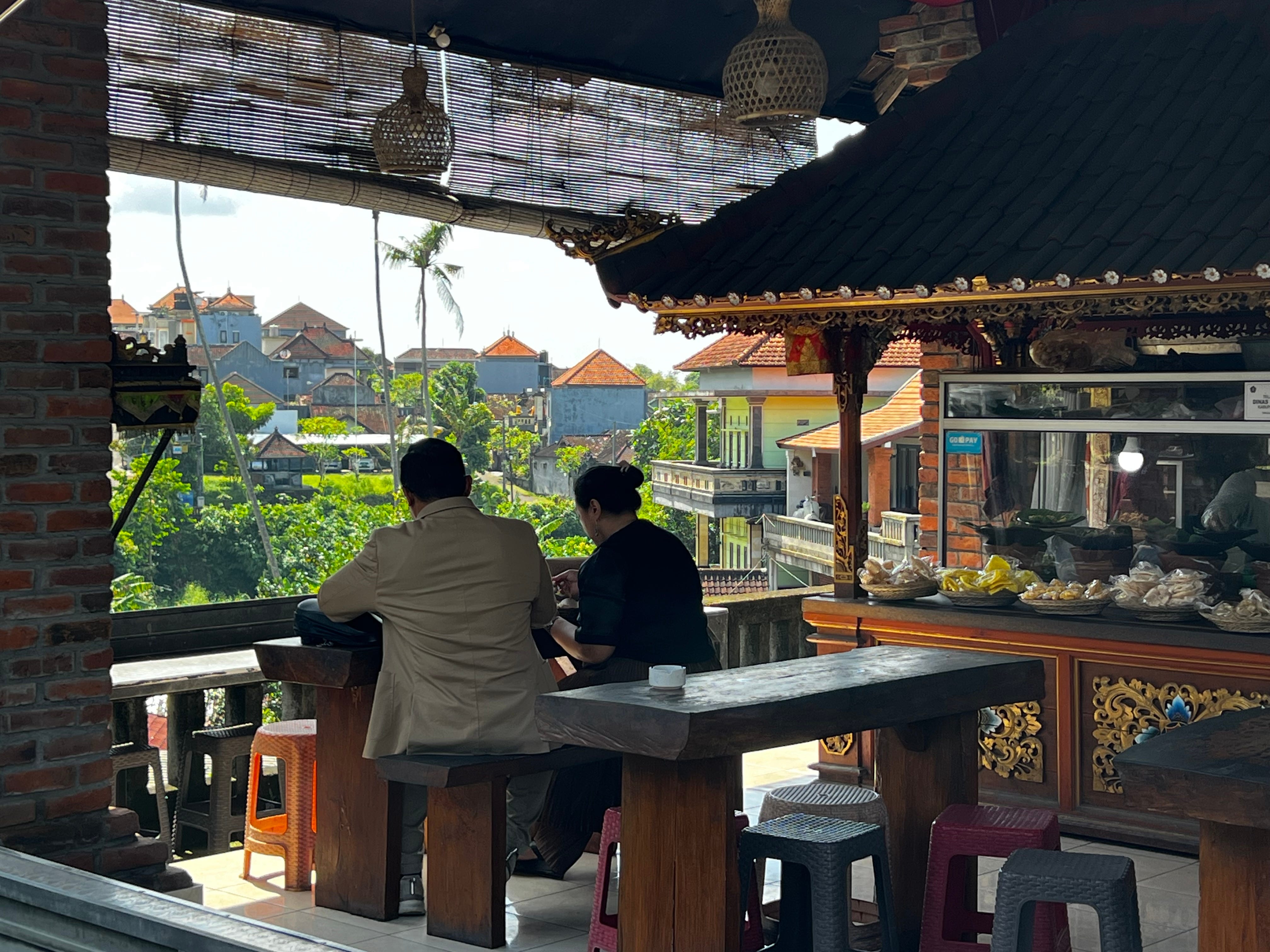
The benches filled while we ate. People looked at me. Agus caught me noticing and laughed. They don’t get many tourists out here, he said, and went back to his rice.
Later I asked him why I almost never saw other tourists in a place like this. He thought about it. The warung is simple, he said, the food is served in a way they aren’t used to, and some of them decide it isn’t clean. The ones who stay long enough, he said, stop deciding that. What he liked about it, he told me, was the building. It was old Balinese, the real kind, and the room stayed cool and calm.
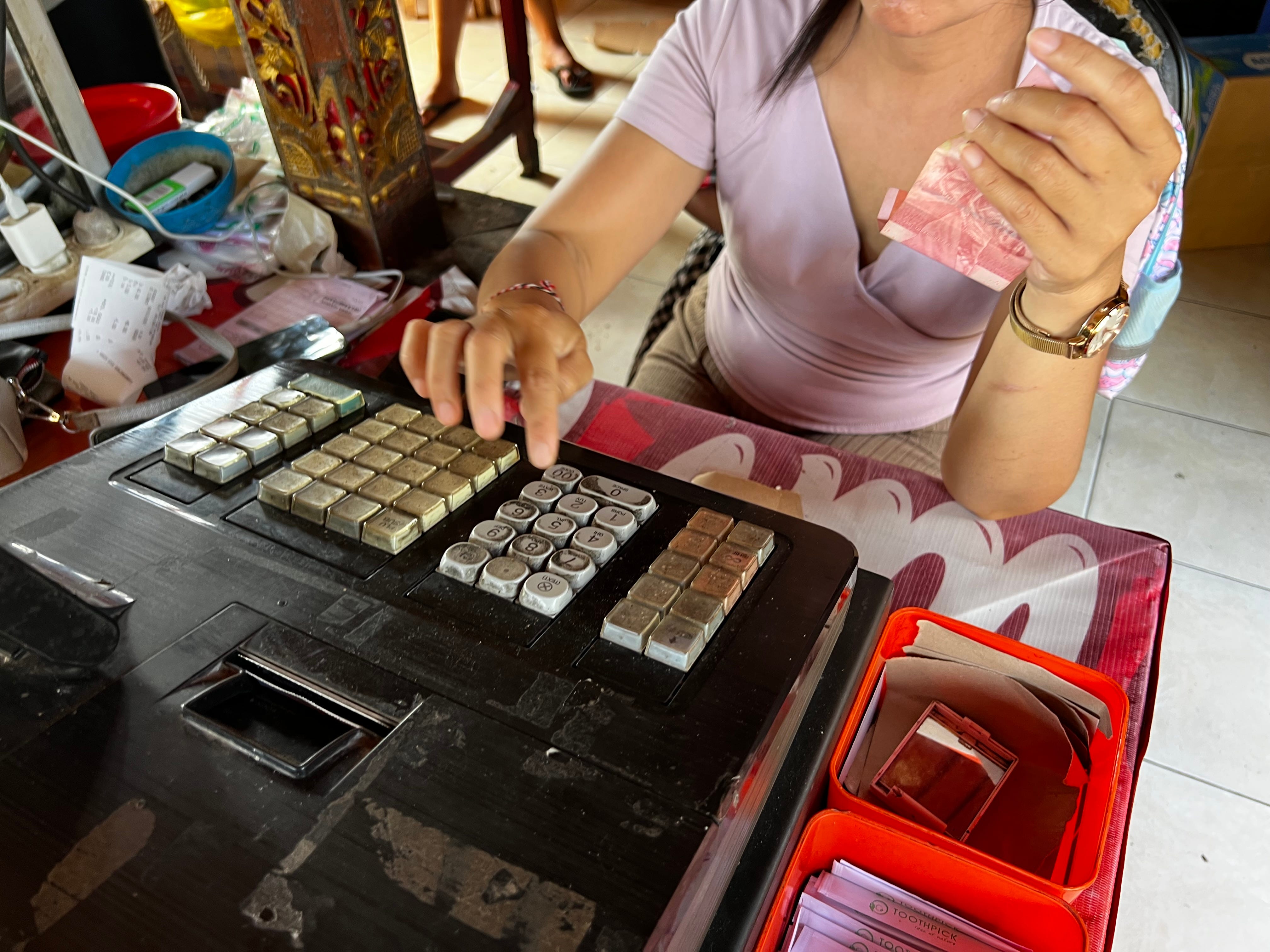
At the counter a woman made change from a worn till, a pink 100,000 note in one hand. On her other wrist, at the edge of the cash drawer, a red thread knotted at the temple and left to wear away on its own. No one in the room but me looked at it twice.
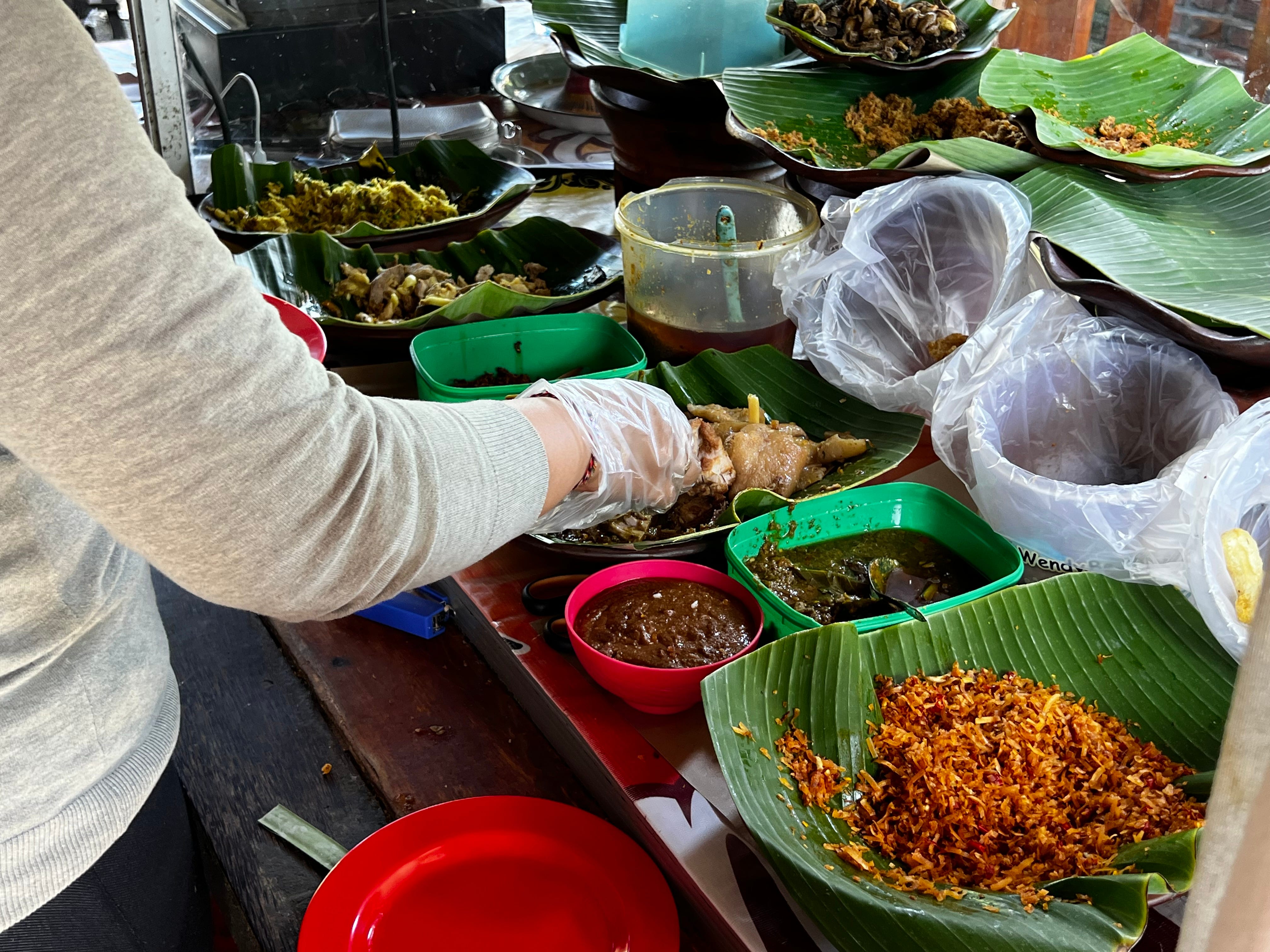
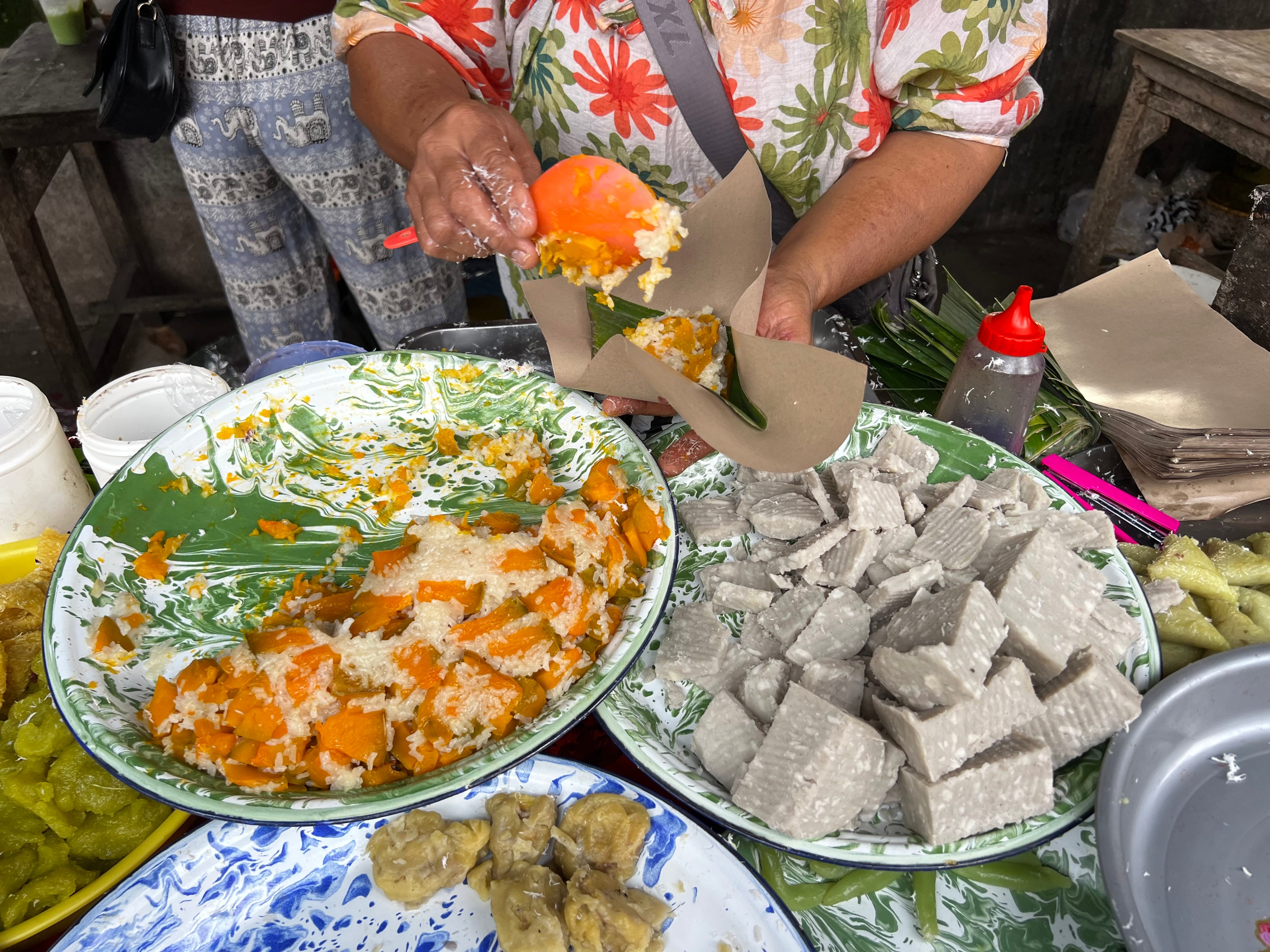
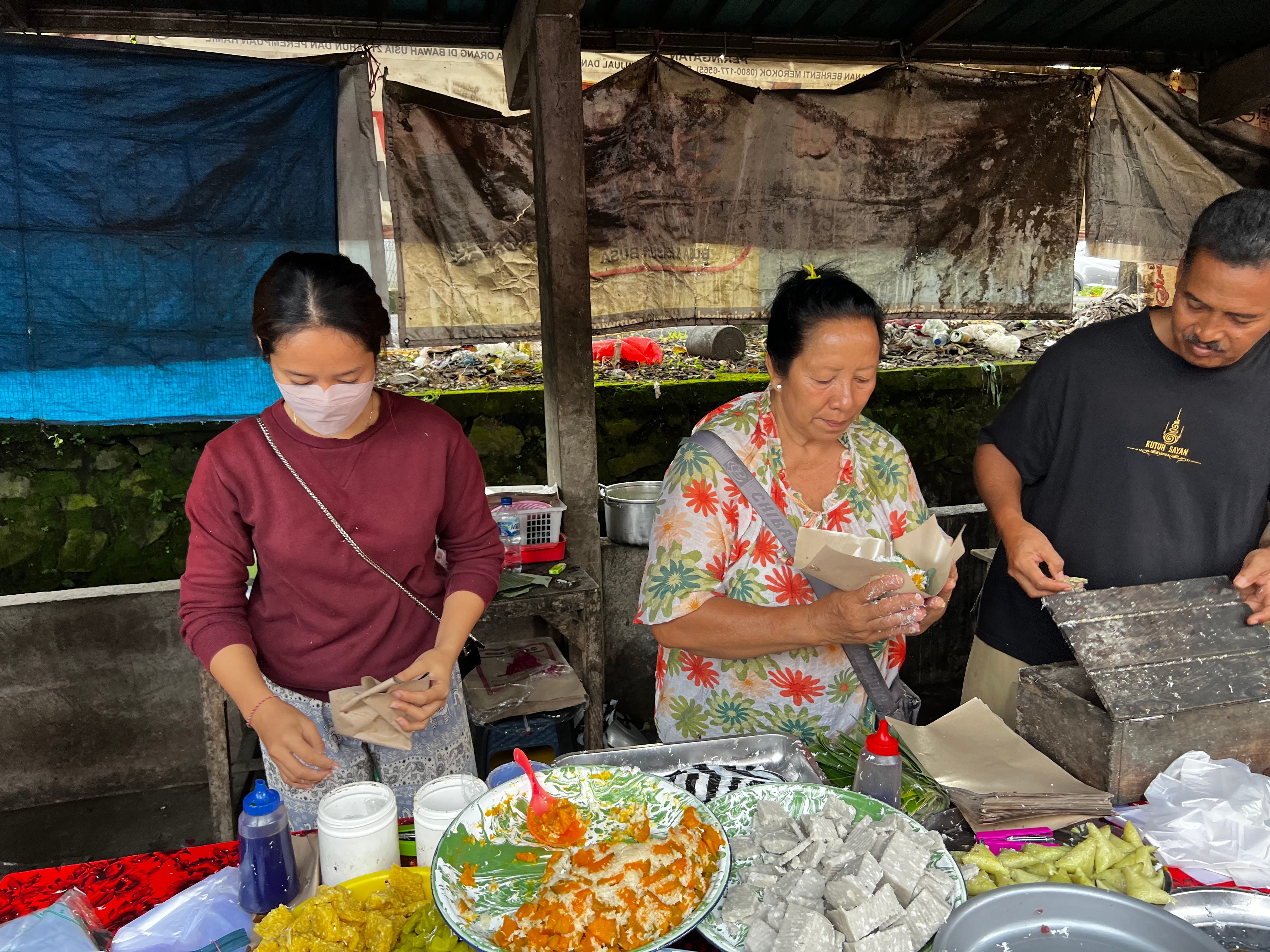
Across town, Pasar Sayan opens in the dark and is mostly over by mid-morning. Agus pointed me toward what people buy there to start the day. Three women worked a low table crowded with enamel platters, the food on them in colors I had no names for, a burnt orange, a soft grey, a red so deep it was nearly black, some built on rice, some on coconut, some folded into banana leaf and tied. One woman spooned what I pointed at into a cone of leaf. Another counted my change. A third never looked up from her folding.
This was fast too, in the oldest way. Cooked before any customer came. Portioned by hand. Wrapped to carry out on a motorbike and eaten before the heat of the day turned it. Nothing wore a label, nothing carried a date, because nothing here was meant to last past the morning it was made for. By noon the platters would be empty and the women gone.

Most mornings started with a knock on the villa door. Ardana owned the villa and lived in the family compound around it. He carried the tray along the edge of the pool, and before he stepped from the path onto the kitchen floor he slipped off his flip-flops and left them at the line where the tile started.
I wanted the gesture to mean something private for him, some small daily devotion. It didn’t. Everyone did it. All over the island people stepped out of their shoes at the threshold of a room, even when the room was half open to the sky. Ardana was just doing the ordinary thing. The meaning was mine, not his. It was the same reflex that had made me distrust the orange.
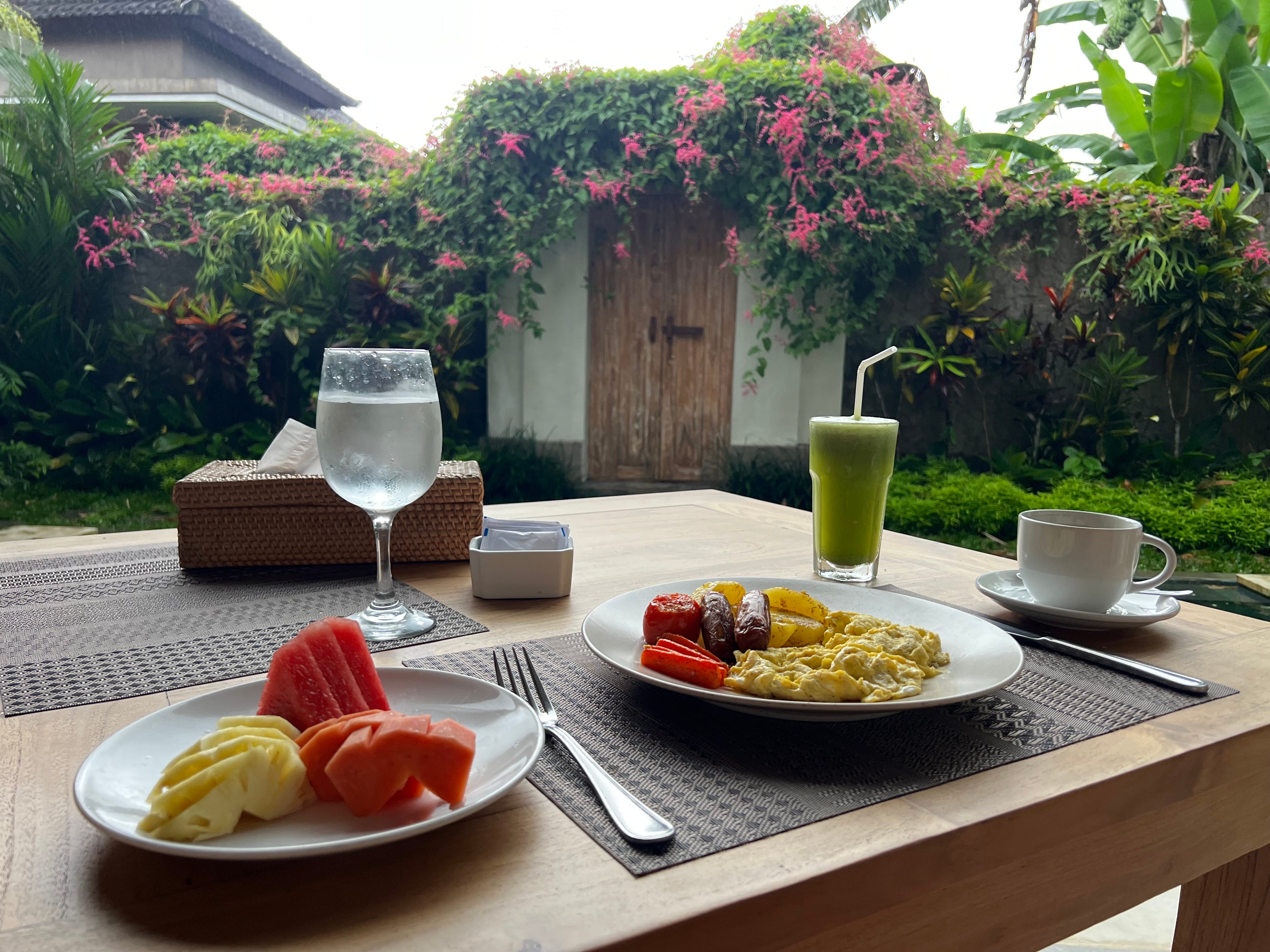
He cooked it himself, which surprised me, and he was good. Eggs, potatoes, a tomato blistered in the pan, fruit cut and fanned out, a green juice, and coffee. He had worked in hospitality in the States before coming back to Indonesia, he told me one morning, and you could see it in the plate, the fruit arranged, the fork squared to the edge. He made it fresh at whatever time you asked for. I slept late, so mine came around 10, the eggs still soft, the potatoes just off the heat. He kept an American breakfast on the menu too, pancakes and sausage, which I never ordered.
It took me most of the trip to see what was on the table. It was the same thing I went looking for at the warung and the market: food made by one person, that morning, by hand. It had been coming to me every day while I scrolled on my phone.
I had paid for it, but not in a way that made me look at it. The breakfast was included in the villa, absorbed into the room rate until it arrived each morning looking like something the place produced on its own. The same exchange rate that made the orange cost me almost nothing put Ardana on the other side of the door with the tray, and turned what I had treated as sacred into an amenity I had stopped seeing by the second day. The care I came so far to find had been plated, in part, with skills Ardana learned in the country I had flown away from.

A couple of weeks later, I went and sat in a KFC. It was bright and cold, the floor pale tile, families at fixed stools, and along one wall in tall letters, HARVEST, and under it, NO WASTE NO HUNGER. A case of sauce bottles glowed by the registers. Agus said the chicken was local and worth trying, so I ordered a few pieces to see if local tasted like anything. It didn’t. It tasted like KFC.
Agus hadn’t talked about it the way I would have, as a foreign thing dropped on the island and rearranging it. He talked about it like a place he liked. And the chain had met him halfway. It learned to serve the chicken over rice with a packet of sambal, the way people actually eat here, put porridge on the breakfast menu, built rice bowls, named a burger after the lunar new year. In 30 years on the island, the chain had become a little more Indonesian. And I still couldn’t answer the simplest question about the chicken back home: Where it had been, what it ate, how far it traveled to the oil.


To Agus, KFC was nearly the same as McDonald’s, he said, a few different items at about the same price. Both of them, to him, were somewhere you went once in a while, not somewhere you started your day.
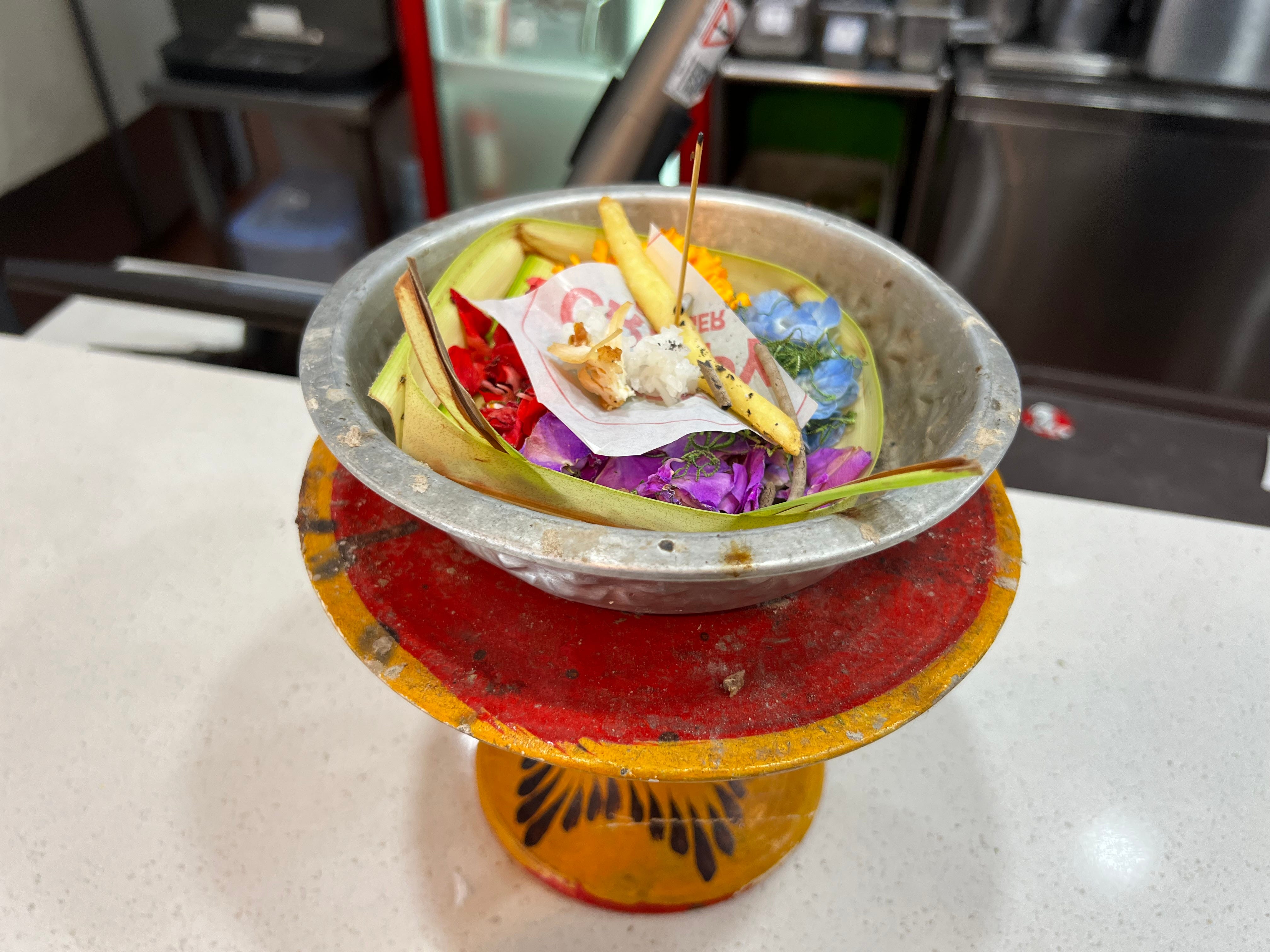
By the register, on a small painted stand, was the morning’s offering. A square of banana leaf, flowers in red and purple and blue, a few fries tucked in among them, a stick of incense burned down. It sat at the elbow of the cash drawer and no one working the line looked at it twice.

By the time I think back to that morning at Arum Coffee, I don’t remember the wait as empty time.
I remember the man taking the orange from the basket. The green skin, the knife, the halves opening to the color I had expected too late. I remember the press turning under his hand, the juice running into the cup, the cap pressed down, the handoff across the counter.
Then I carried it to the bench facing the street and drank it while the scooters went by, warm at the top from his hands and cold underneath from the fruit.
I had come to Bali thinking I knew what I was looking at. I didn’t. The orange could be green and ripe. The fries could sit in the offering. The thing I thought I was waiting on had been happening in front of me the whole time.
What needed time was me. ⁂

