

Whose Mafia?
Why whiteness, not queerness, defines who gets proximity to power in Silicon Valley.

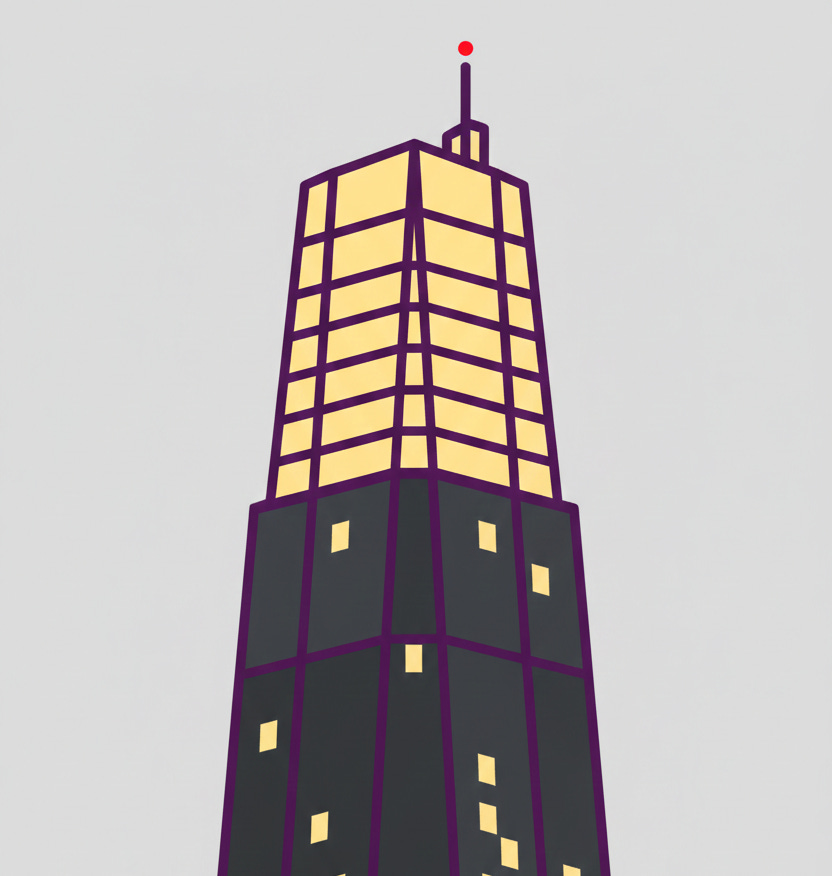
Last week, WIRED published a feature called “Inside the Gay Tech Mafia.” It named Peter Thiel, Sam Altman, Tim Cook, and Keith Rabois. It described pool parties in San Francisco, deal flow over dating apps, social networks that double as professional ones. The reporting was extensive. The illustrations of muscular torsos, a handshake emerging from between two men’s crotches, and a skyscraper standing in as a phallus were camp. The comments section caught fire. People called it homophobic. People called it gossip. People called it dangerous. People said it read like something from Gawker, or Breitbart, or the prelude to a new Lavender Scare.
I read it and thought: none of this is about me.
Not because I’m not gay. I am. Not because the subject doesn’t matter. It does. But because every person named, every party described, every network mapped in that piece operates inside a world that is specifically, almost exclusively, white. The essay never says this. It doesn’t have to. The illustrations did it for me. The bodies are white, the settings are San Francisco, and one source in the piece uses the phrase “Greco-Roman gays.”
This isn’t incidental. Over 80% of U.S. venture capitalists are men. Around 70% are white. Nearly 60% are white men. The rooms Bernard describes — the dinners, the deal flow, the social infrastructure that doubles as professional access — exist inside an industry where whiteness is the default at every level of power. The people she profiles are gay in a context where whiteness and wealth grant entry most queer people will never have. Bernard profiles a specific network. But the conversation her piece generated (and the reactions to it) collapsed that specificity into something universal by treating “gay” as if it were a single experience. As if the pool parties and the deal flow and the sexual social capital are available to anyone who happens to be queer and interested in tech.
They are not.

Bernard includes a statistic near the end of the piece, almost in passing. Between 2000 and 2022, only 0.5% of startup venture capital funding went to LGBTQ+ founders. She uses it to complicate the “mafia” narrative — if gay people controlled tech, the number would be higher.
She’s right. But that number deserves more weight than a complication.
The data comes from StartOut, which analyzed $2.1 trillion in funding across that period. More telling is performance: LGBTQ+ founders who do get funded create 36% more jobs, file 114% more patents, and produce 44% more exits, while raising 16% less capital. The talent is there. The money isn’t.
And within that already thin slice, there’s a hierarchy that mirrors every other hierarchy in venture capital. A 2023 report from Proud Ventures found that gay men raise a median of 22 times more in total funding than lesbian founders. One VC firm, Chasing Rainbows, noted that the gap is steepest for “intersectional queer founders, trans founders, and founders who act ‘too femme’ or ‘too butch.’”
So when WIRED describes a “gay tech mafia,” it is describing something real, but something very narrow. A network of wealthy white gay men whose proximity to capital, whiteness, and a particular version of masculinity gives them access to rooms that most queer people will never enter.
In 2024, seven organizations — including StartOut, BLCK VC, Diversity VC, and SomosVC — formed the Diversity Data Alliance to standardize demographic tracking across venture capital. As StartOut noted, improved tracking would be “vital” to understand funding for underrepresented intersectional entrepreneurs.
They don’t have the number yet.
We know that less than 3% of VC-funded startup founders are Black. But the intersections of Black and queer, Latinx and queer, and trans and a person of color remains largely unmeasured.
The “gay tech mafia” discourse assumes a universal queer experience of power and proximity. The data shows a steep gradient, and at the bottom of it, there isn’t even a measurement. You can’t be underfunded if no one is tracking whether you exist.

The comments on the WIRED piece are telling, but less for what they argue than for what they reveal about who gets to define the terms of the debate.
Some commenters called the piece homophobic. Some called it dangerous. Some said the framing — “mafia,” the sexualized illustrations, the implication that gay men leverage intimacy for professional gain — plays into stereotypes that have been used to harm queer people for decades. Those concerns aren’t baseless, especially now, when LGBTQ+ rights are under direct political attack. Others pushed back, pointing out that Bernard’s reporting describes how power networks function and that the discomfort isn’t with the behavior, but with who’s doing it. The strongest version is that straight men have built professional networks through social and sexual capital for centuries and nobody called it a mafia.
Both sides assume they’re debating whether the piece is fair to gay men. Neither is asking: which gay men?
One commenter, in two words, saw it clearly. “White. You forgot to state that they are white as well as gay.”
It had almost no engagement.
I am not arguing that Black gay men or other queer men of color are incapable of building the kind of networks Bernard describes. I am not arguing that proximity to power is inherently wrong. I am arguing that the conversation treats queerness as if it automatically confers shared experience, shared access, shared stakes — and it doesn’t. The networks in that piece were built by and for a very specific kind of gay man. The social infrastructure of venture capital is racially specific. The data confirms it. The question is about access.
And until someone counts the rest of us, the conversation will keep mistaking a very narrow corridor of privilege for the whole house. ⁂