This is the second entry in LONGITUDE, a series for paid subscribers told through place. The first was Bangkok.
Soundtrack: motorbike engines / honking through Quan 4 / Google Translate’s voice / Grab car notifications
I didn’t know what to call it before I got there.
Ho Chi Minh City is the official name. Saigon is what most locals still say, at least in the south, because it’s shorter and it’s what their parents called it and their grandparents called it before the war ended in 1975 and the name changed with it. The airport code is still SGN. The city’s biggest newspaper is still the Saigon Times. Both names exist at the same time, in the same conversations, and nobody seems to feel the need to choose.
I didn’t know that before I arrived. I also didn’t know a lot of things.
Growing up in the United States, what I absorbed about Vietnam came mostly through the filter of a war. I was born in 1982, seven years after it ended, but the images were everywhere. History textbooks. Movies. The way adults talked about it. If you asked me at 15 to picture Vietnam, I probably would have described rice paddies and straw hats and poverty. A country that America broke and never quite apologized for. A place that existed primarily as the setting for American trauma.
I don’t think anyone sat me down and said this directly. It was more ambient than that. The kind of understanding you inherit without anyone handing it to you, absorbed through curriculum and culture and the way a country talks about a place it once bombed.
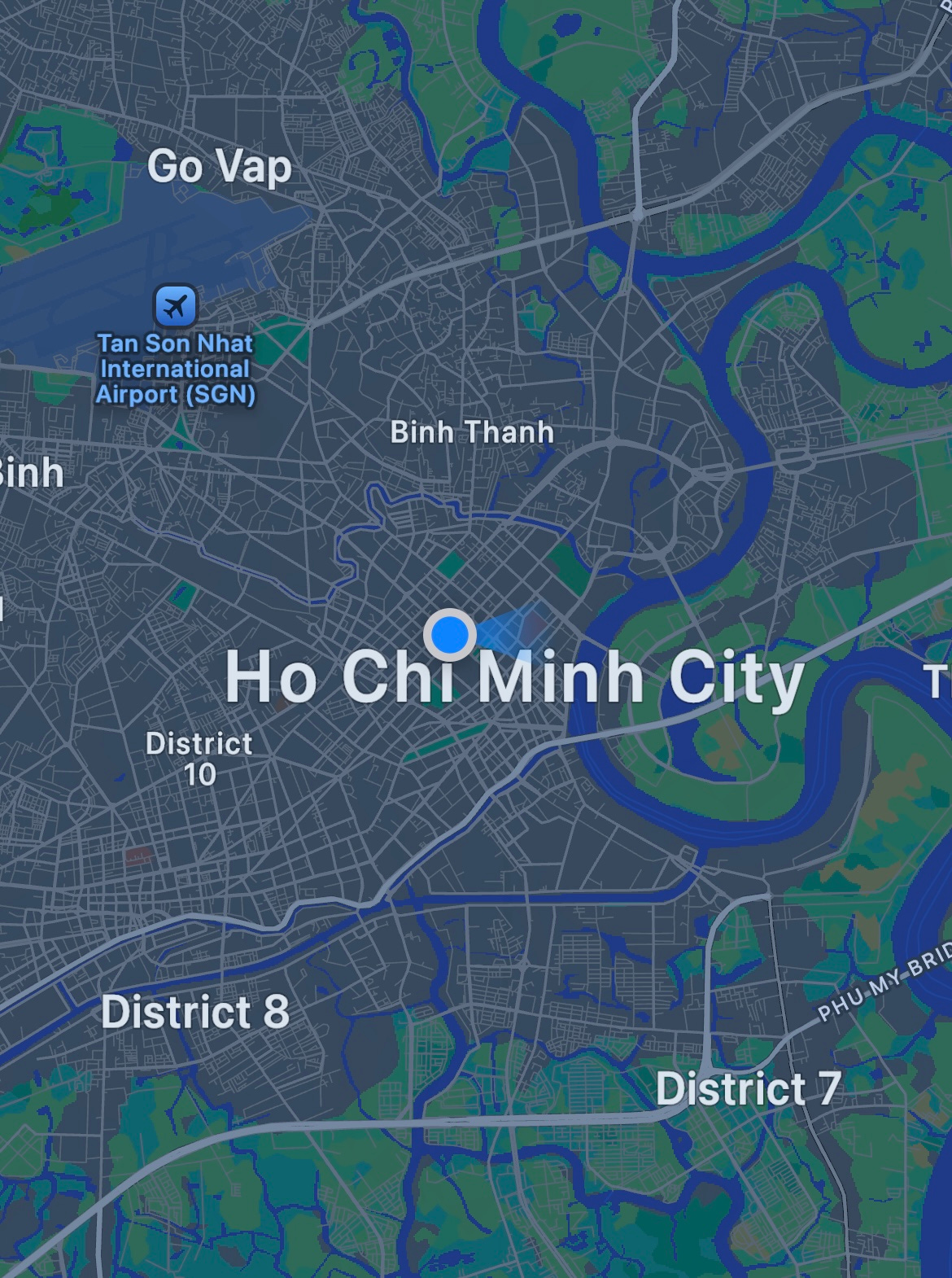
So when the car from the airport turned onto the main road and I saw what was actually there, I didn’t know what to make of it at first. I just started recording on my phone.
The motorbikes were the first thing. Thousands of them, moving in patterns that looked like chaos from inside the car but clearly weren’t. Everyone wearing helmets. Drivers and passengers. In Bangkok, helmets had seemed optional. Here they were the rule. The bikes outnumbered cars by what felt like 10 to 1, weaving through intersections with a coordination I couldn’t decode, but that clearly worked because everyone kept moving and nobody crashed.
The buildings were the second thing. New construction everywhere. Glass towers. Cranes. Apartment complexes that looked like they were finished last month. This was not the Vietnam I was taught to imagine. This was a city that was building itself fast and didn’t need me to understand it.
I remember thinking: how much of what I thought I knew about this country was just American propaganda left over from a war that ended before I was born?
I lived in Quan 4, District 4, in a building overlooking the Saigon River.
The neighborhood is a small triangle of land surrounded by water, wedged between the tourist center of District 1 and the newer developments to the south. A bridge and a 10-minute walk separated me from the restaurants and landmarks most foreigners come to see. District 4 used to have a rough reputation decades ago. Now it’s mid-transformation, new high-rises going up along the riverfront while the older neighborhood continues behind them. Street vendors and wet markets and narrow alleys, all of it still there, just with cranes visible over the rooftops.
I chose it for the same reason I chose Bang Sue in Bangkok. I wanted to be close enough to access the center, but far enough that I wasn’t living inside it. I wanted a neighborhood that wasn’t performing for tourists.
My apartment was nicer than I expected. New building. Clean. A view of the river from the balcony that I never got used to, not because it was spectacular in some postcard way, but because every time I looked at it I had the same thought: I live here right now. This is where I wake up.
Two views from my apartment balcony in Ho Chi Minh City — a quiet river morning beneath towering clouds and the rhythm of street life below, where motorbikes and sidewalk meals shape the everyday scene.
My days had a rhythm.
Gym in the morning. Breakfast. Then I’d walk the neighborhood or catch a Grab across the bridge to District 1 and just take things in. In the evenings I was back in the apartment, working, aligning with London or US hours depending on the meetings. Some nights I would go out again. Some nights I would stay in.
It sounds simple because it was. I wasn’t on vacation. I was living my regular life with a different backdrop. That was the point.
But the backdrop changes things in ways you don’t expect.
My phone had to be charged at all times. Google Translate was how I communicated with anyone beyond pointing and gesturing. The Grab app was my only reliable way to get around. So I was always aware of my battery percentage in a way I never am at home. I would plan my outings around it. How long can I be out before I need to get back and charge? Can I make it to District 1 and back before my phone dies? If I get lost, do I have enough battery to call a car?
It sounds small. But it restructured my entire relationship with movement. Every time I left the apartment, there was a calculation happening underneath the exploration.
I got stared at a lot.
I don’t know if it was because I’m 6’3, or because I’m Black, or because I was almost always alone. Maybe all three. Maybe none. That’s the thing about being visibly foreign in a place where you can’t understand what anyone is saying around you. You become a surface for your own projections.
When I’d show up to restaurants, tours, activities, I almost always got the same question: alone? Just you? Said with genuine surprise, like solo wasn’t really an option they’d considered. I would say yes, and they’d look at me for a second before moving on.
I wrote about specific encounters from my time here in two other essays. One about what everyday transactions revealed about race, power, and who gets forgiven. Another about what a nail salon revealed about labor, currency, and the American passport I carry.
Both of those deal with moments where I watched my inherited American frameworks collide with what was actually in front of me. I won’t retell them here. But something was running underneath both of them that I couldn’t see clearly until I had been in the city longer.
I arrived in Vietnam carrying an entire operating system built by the United States. A way of reading race, class, power, and history that was installed in me before I was old enough to question it. In America, that operating system mostly works. Or at least, it works well enough that you stop noticing it’s running.
In HCMC, it crashed constantly.
A woman at a checkout counter doesn’t smile at me the way she smiled at the white customer before me, and my American brain immediately starts running its program: racism, colonial history, who has power here, what does this gesture mean. But I’m in Vietnam. The program doesn’t apply the same way. Maybe it partially applies. Maybe it doesn’t apply at all. I can’t know, and not knowing is the point.
That uncertainty followed me everywhere. And over time, I started to realize that the discomfort wasn’t coming from Vietnam. It was coming from the fact that the only interpretive tools I had were American ones, and they kept producing answers that might be wrong.
Ho Chi Minh City skyline at night, viewed from the Saigon River.
I knew I was going to do a boat ride so I bought a ticket for a sunset river tour.
They gave us gelato and we watched the city from the deck. I went alone. The sun going down over a city of 14 million people, turning everything gold, then orange, then dark. By the time we docked, it was night. The whole city had changed color while I was sitting there.
And I thought about how when I was growing up, we didn’t have money for vacations. The only trips I remember were the five of us piling into a maroon Astro van and driving from Maryland to North Carolina or Georgia to visit grandparents. Eight hours, one row of backseat, three kids shoulder to shoulder fighting over who got stuck in the middle. My mom is from NC. My dad is from GA. That was travel.
No Disneyland. No flights anywhere. No passports until I was an adult.
So sitting on that boat, in that city, on that river, I wasn’t thinking about colonial echoes or algorithmic bias or inherited American propaganda. I was thinking, I’m here. In Saigon. On a boat. Eating gelato. And nobody in my family has ever done this.